You know that feeling when your beautiful deck just looks… unfinished? That awkward, empty space underneath can throw off the whole vibe, but figuring out how to finish it can feel overwhelming. We get it. That’s why we dove deep into the options at places like Home Depot and Lowe’s, filtering through hundreds of looks to bring you only what’s worth your attention.
Inside, you’ll find 32 distinct deck skirting ideas, from classic wood lattice and modern horizontal slats to rugged stacked stone and sleek composite panels. We’ve covered everything from simple DIY projects around $500 to professionally installed stone veneer systems that can run up to $8,000. For 2026, it’s all about treating your outdoor areas like true extensions of your home, and finishing the details is a huge part of that trend. A great skirt doesn’t just hide junk; it completes the architectural look of your home. And stay until the end — we break down the most common mistakes that can ruin these looks. 📌 Save this to Pinterest for later — you’ll want to revisit these ideas.
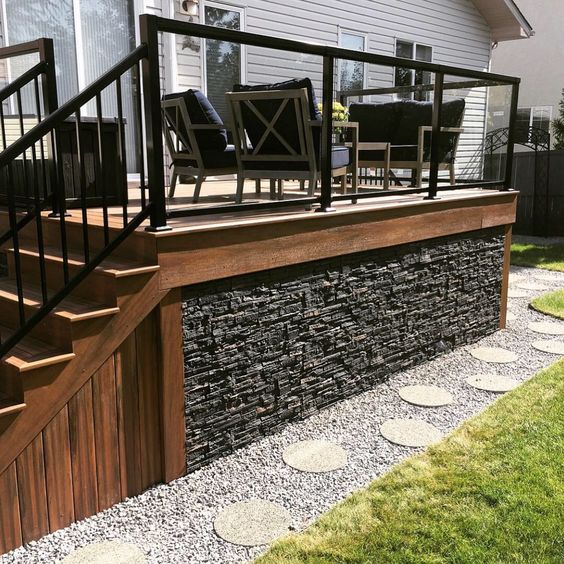
1. Modern Deck with Dark Stone Veneer Skirting and Gravel Path
This look succeeds by masterfully blending textures and colors. The dark, textured stone veneer provides a strong, earthy anchor for the entire structure, preventing the raised deck from feeling like it’s floating. This visual weight is balanced by the warmth of the reddish-brown wood and the sleek, modern lines of the black metal and glass railings. The contrast between the rough stone, smooth wood, and crisp glass is what gives this design its sophisticated, high-end feel. It’s a study in balancing rustic materials with contemporary finishes.
💡 Designer Tip
When using stone veneer for skirting, always install a proper weather-resistant barrier and drainage mat behind the panels. This is non-negotiable. It prevents moisture from getting trapped against your deck’s wooden framing, which can lead to rot and structural failure over time. For the gravel bed at the base, use a landscape fabric underneath to suppress weeds and ensure your clean, crisp look lasts. Aim for a gravel depth of at least 3-4 inches for good coverage and a satisfying crunch underfoot.
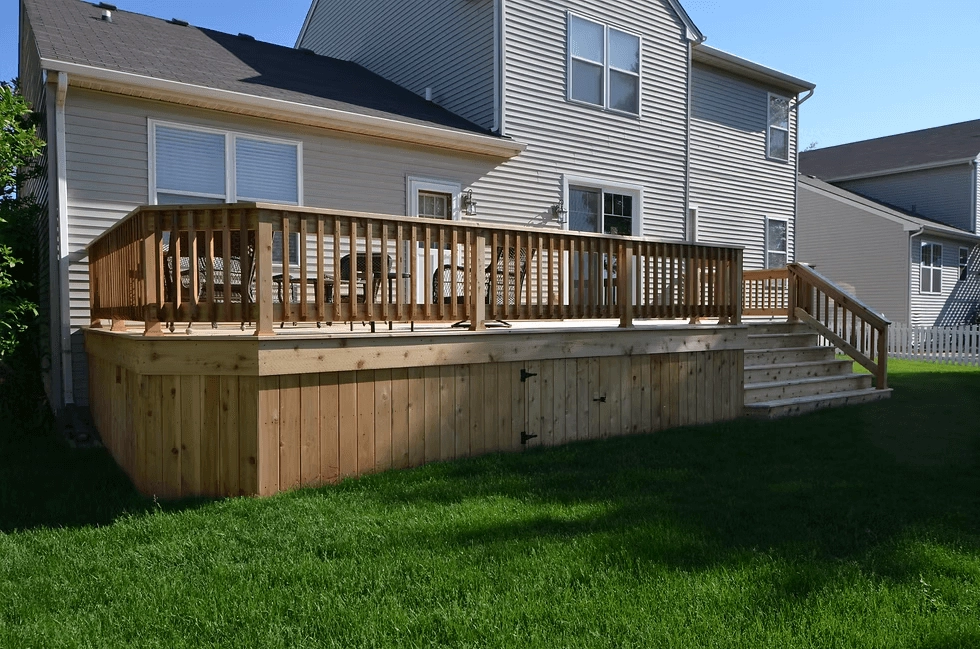
2. Natural Wood Deck with Vertical Plank Skirting and Access Doors
Let’s be honest: that under-deck space is prime real estate for storage. But if you fully enclose it, you need a plan for access. Integrated doors like these are brilliant, but they need to be built correctly. Ensure the door frame is squared and reinforced so it doesn’t sag over time, and use high-quality outdoor hinges and latches that won’t rust in the first year. Also, consider what you’re storing. If it’s anything that can’t handle dampness, this might not be the dry, sealed storage unit you’re imagining.
💰 Budget Breakdown
The single element that makes this work so well is the seamless integration of the access doors. By using the exact same vertical planking and keeping the hardware minimal and dark, the doors almost disappear into the skirting. It’s a perfect marriage of form and function. Without them, it’s just a wall of wood. With them, it’s a clever, practical design feature that adds immense value without sacrificing the clean, cohesive aesthetic. It acknowledges the reality that we all have stuff to hide.
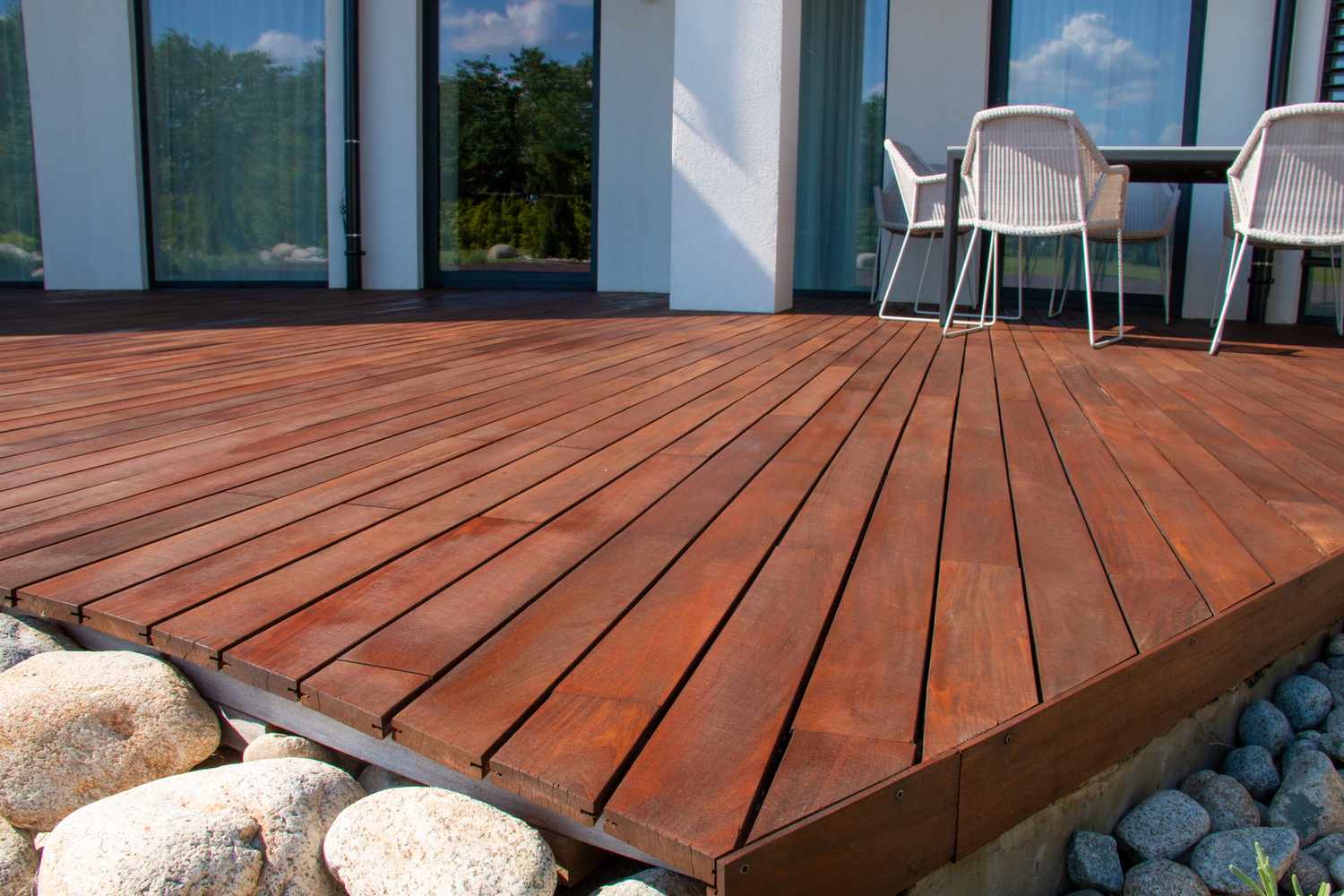
3. Dry-Stacked Stone Skirting with Lush Plantings at the Base
Real dry-stacked stone can be pricey due to the labor involved. To get this organic, textured look for less, look for stone veneer panels. Brands like Airstone or GenStone offer lightweight, DIY-friendly panels at major hardware stores for about $80-$120 per box. These panels are designed to interlock, which simplifies installation dramatically. You can attach them to a plywood or cement board backing secured to your deck frame. The look is incredibly convincing, and you’ll save thousands on a mason’s labor costs.
🔧 How-To Brief
The formula here is all about natural texture: 60% irregular stone + 30% soft foliage + 10% dark accents. The majority of the visual is the light-colored, randomly patterned stone. This is softened by a generous border of leafy green plants, which breaks up the hardscape. The final 10% comes from the dark deck support posts, which add just enough contrast to define the structure. You could swap the stone for a warmer, terracotta-toned veneer and the plants for ornamental grasses, and the harmonious balance would still work perfectly.
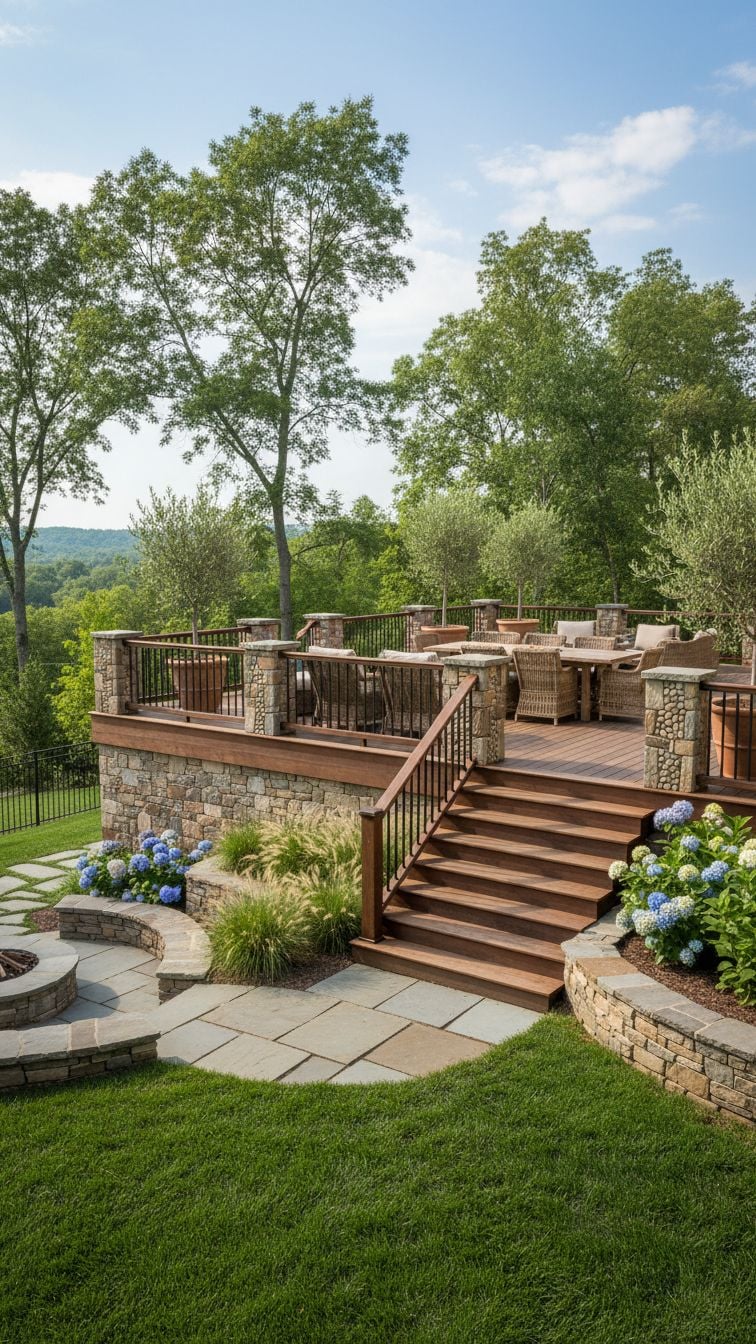
4. Elevated Deck with Stacked Stone Masonry and Dark Wood Trim
Natural stacked stone is incredibly durable, but it’s not zero-maintenance. The biggest task is checking for weeds or moss growing in the crevices, especially in damp climates. A stiff brush and a pressure washer on a low setting once a year will keep it clean. The dark stained wood trim, however, will need more attention. Expect to re-stain or seal it every 2-3 years to protect it from UV damage and moisture, which will cause it to fade to a sad gray. This is especially true for the horizontal cap, which takes the brunt of the sun and rain. Compare this with the composite in Idea #5, which requires less upkeep.
⭐ The One Thing
This design feels so integrated and permanent because it uses the same material—the natural stacked stone—for the skirting, support posts, and surrounding retaining walls. This repetition creates a powerful sense of cohesion, making the deck feel like it grew out of the hillside rather than being placed on top of it. The dark wood trim acts as a clean, crisp dividing line, providing a visual transition from the rugged stone base to the finished deck surface above. It’s a classic technique that adds definition and polish.
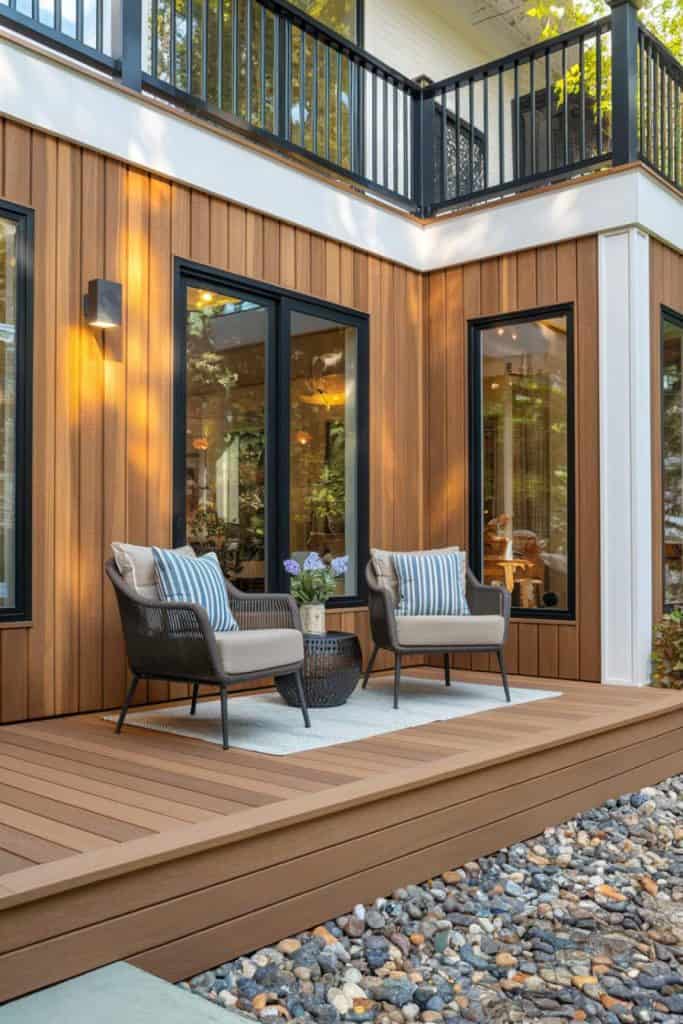
5. Warm Composite Deck with Layered Skirting and a Pebble Border
Creating a clean pebble border is a fantastic weekend project. Here’s a quick guide:
- Define the Edge: Use a spade to cut a clean trench, about 4-6 inches deep, around the perimeter of your deck.
- Install Edging: Place a flexible plastic or metal landscape edging into the trench. This is key to keeping your pebbles contained and out of the lawn. Backfill with soil to secure it.
- Lay Down Fabric: Cover the entire area inside the edging with a high-quality, permeable landscape fabric. Overlap seams by 6 inches and secure with landscape staples.
- Add the Pebbles: Pour in your river pebbles to a depth of at least 3 inches. This ensures full coverage so the fabric doesn’t show through.
Time: 3-4 hours. Cost: $150-$300 for a 50-foot perimeter.
🧹 Maintenance Reality
This look is popular right now because it taps directly into the trend of low-maintenance, high-style outdoor living. Homeowners are tired of mulching every year. A permanent river pebble bed, like the one shown, offers a one-and-done solution that looks polished and intentional. The layered composite skirting also speaks to our desire for finished, architectural details outside. It’s no longer enough for a deck to be just a platform; we want it to have the same thoughtful design as our indoor spaces.
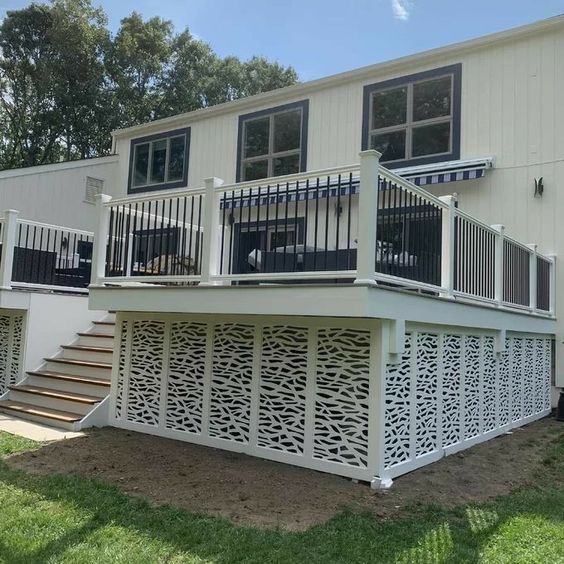
6. White Deck Skirting with an Organic Cut-Out Pattern
When using decorative panels like these, backlighting is your best friend. Installing simple, low-voltage LED strip lighting along the inside top edge of the skirting will transform your deck at night. The light will shine down and through the organic cut-outs, creating a beautiful play of light and shadow on the ground below. It turns a simple skirting into a dramatic landscape lighting feature. Make sure to use exterior-grade, waterproof LEDs and position them so the light source itself isn’t directly visible from the outside.
🎯 What Makes It Work
It’s all about the patterned panels. Remove them and you have a standard, maybe even boring, white deck. But with them, the skirting becomes a significant decorative element. The organic, leaf-like pattern adds a layer of artistry and softness that you rarely see in deck design. It turns a functional requirement—hiding the underside of the deck—into a major style statement. It proves that skirting doesn’t have to be just a solid wall of wood or lattice; it can be a place for creative expression.
7. Modern Horizontal Wood Slat Deck Skirting on a Stone Patio
This horizontal slat style works best on low-profile decks, typically those no more than 18-24 inches off the ground. When the deck is too high, a horizontal pattern can start to look like a giant fence and feel overwhelmingly linear. For a small patio deck of about 10×12 feet, this look is perfect. The clean lines help the space feel wider. If your deck is higher, consider breaking up the expanse with vertical posts or changing the direction of the slats, similar to what you see in the privacy screen in Idea #28.

✅ Before You Start
While horizontal slats look incredibly sharp and modern, they can be a bit of a pain to clean. Leaves, cobwebs, and dirt love to collect on the top edge of each individual board. You’ll want a hose with a good spray nozzle or a pressure washer on a gentle setting to blast them out a few times a year. Also, the gaps that provide that airy look are an open invitation for small critters to make a home underneath. If you live in an area with lots of squirrels or rabbits, you might want to add a wire mesh screen behind the slats.
8. Low-Profile Composite Deck with Matching Solid Board Skirting
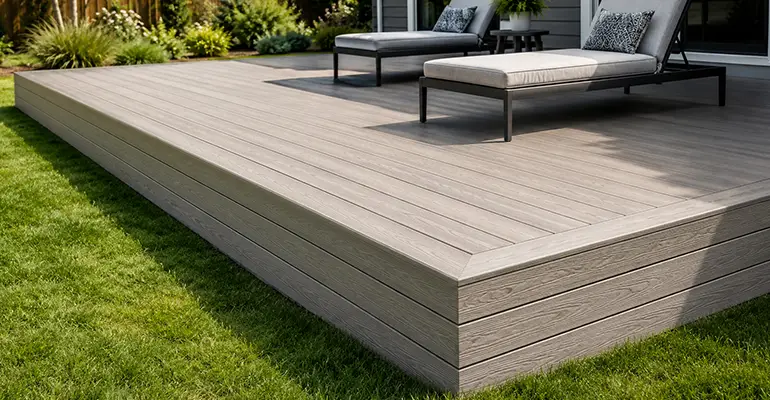
To recreate this seamless, low-maintenance look for a 12’x16′ deck (approx. 192 sq ft) with a 1-foot height:
- Composite Decking & Skirting Boards: $2,500 – $4,500
- Hidden Fasteners & Screws: $300 – $500
- Pressure-Treated Framing Lumber: $800 – $1,200
- Labor (if not DIY): $2,000 – $4,000
- TOTAL: $5,600 – $10,200
Budget alternative: Use pressure-treated wood for everything and paint it a solid grey. Total cost would be about $2,500 – $4,500, a significant saving, but requires yearly maintenance.
🔥 Trending Context
The beauty of this design is its monolithic appearance. Using the exact same light greyish-brown composite material for the decking, the edge trim, and the horizontal skirting boards creates a single, unified object. The mitered corner is the key detail that sells this illusion—it makes the surface and the side feel like they are one continuous piece. This approach gives the deck a clean, modern, almost furniture-like quality, very different from a traditional wood deck where the substructure is often a contrasting element. It’s the outdoor equivalent of a minimalist platform bed.
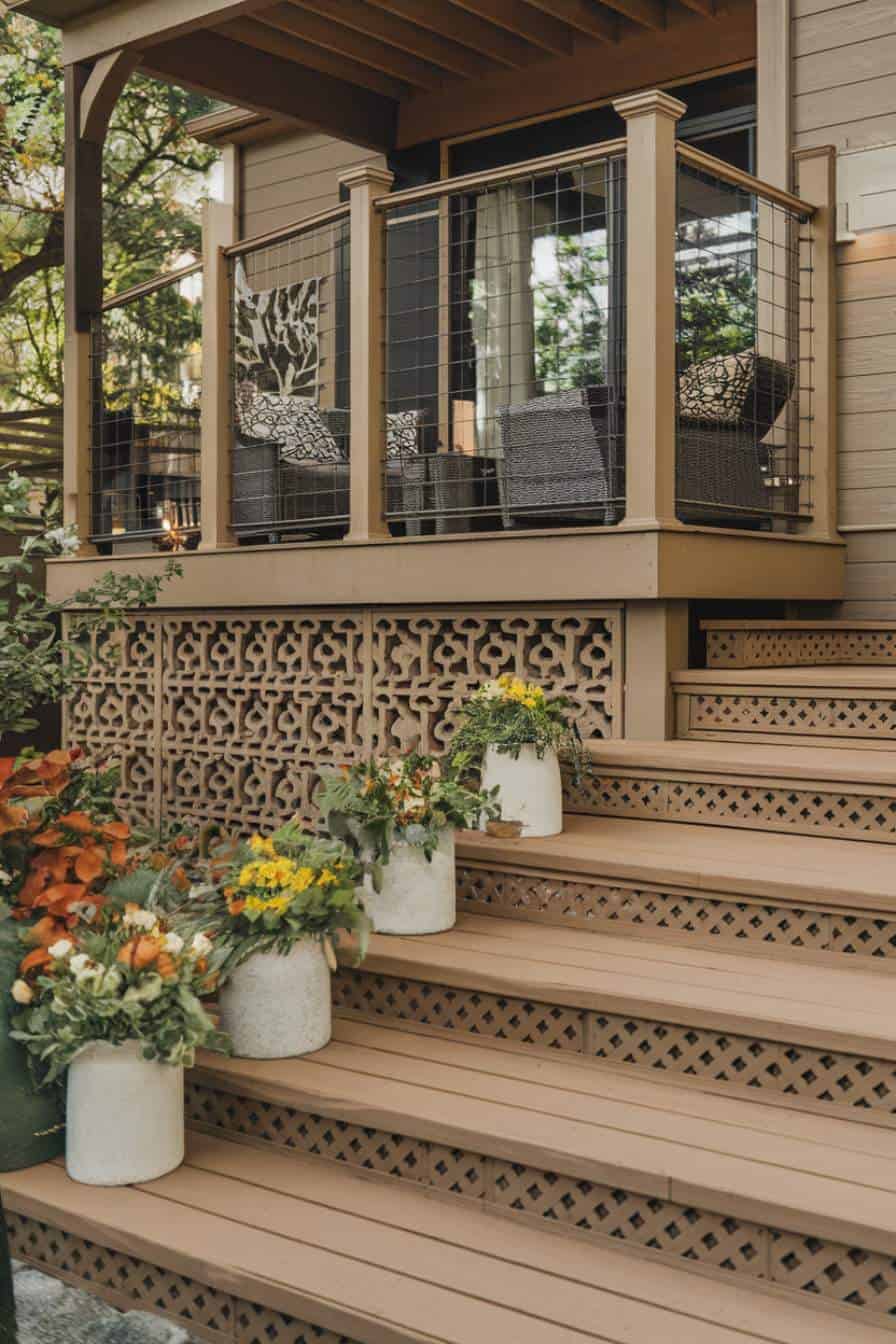
9. Ornate Geometric Patterned Skirting with Matching Stair Risers
The formula here is: 50% warm wood structure + 40% decorative pattern + 10% dark modern accents. The warm brown decking and stairs provide a welcoming and solid base. The ornate geometric panels are the star, covering a large surface area on the skirting and risers to create a huge visual impact. The final touch is the dark wire mesh railings and woven chairs, which add a contemporary edge and keep the look from feeling too traditional or fussy. Swapping the pattern for something simpler would make it more modern; swapping the wood for white would make it feel more coastal.
|
📋 Copy HEX 🔗 Share |
📏 Scale Guide
When using decorative panels, especially on stair risers, material choice is critical. These panels are often made from a composite or plastic material that can be cut with standard woodworking tools. To get clean, sharp cuts that don’t melt or chip the material, use a fine-tooth blade (60-80 teeth) on your circular saw or table saw. Placing masking tape over your cut line before you saw can also help prevent chipping and give you a perfectly crisp edge. It’s a small step that makes a huge difference in the finished quality.
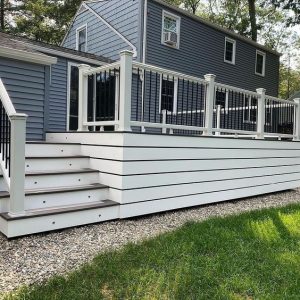
10. Horizontal Slat Deck Skirting with Integrated Stair Lighting
Planning to add integrated lighting? Smart move. Here’s a checklist before you begin building:
- Plan Your Wiring: Map out where every light will go and how the low-voltage wire will run back to the transformer. Do this before you install the skirting or risers.
- Choose Outdoor-Rated Fixtures: Ensure your step lights and any other fixtures are specifically rated for wet locations (IP65 or higher).
- Locate Your Power Source: You’ll need access to a GFCI-protected outdoor outlet to plug in the transformer. Is there one nearby?
- Calculate Transformer Size: Add up the wattage of all your planned lights and choose a transformer that is rated for at least 20% more than your total to avoid overload.
📐 Style Math
This design is a masterclass in using contrast to create visual interest. The crisp white of the horizontal skirting, posts, and risers creates a bright, clean framework. This framework makes the dark composite decking and stair treads pop, drawing your eye to the walking surfaces. The black vertical balusters echo the dark decking, tying the whole scheme together. Finally, the recessed lights add a layer of functionality and ambiance, turning the stairs from a simple utility into a design feature in their own right. It’s a perfectly balanced composition of light, dark, and warmth.
11. Dark Square Lattice Deck Skirting on a Composite Deck
Lattice is one of the most affordable skirting options out there. You can get a 4×8 foot sheet of pressure-treated or cedar lattice for $30-$50 at any big-box hardware store. For a more durable and modern look like the one shown, opt for the vinyl or plastic versions, which run about $40-$60 per sheet. They come in various colors (like black or dark brown) and won’t rot or need painting. Simply cut the sheets to size and attach them to the inside of your deck’s support posts for a clean, professional-looking installation.

⚠️ Real Talk
While lattice is great for providing ventilation (a huge plus for preventing mold and rot), it doesn’t completely hide what’s underneath. From certain angles and in bright light, you’ll still be able to see the support posts, stored items, or bare ground behind it. If your goal is total concealment, this isn’t the right choice for you. Consider a solid board option like in Idea #8 instead. Also, that open grid is a magnet for vines and climbing plants, which can look charming but can also be a maintenance headache to control.
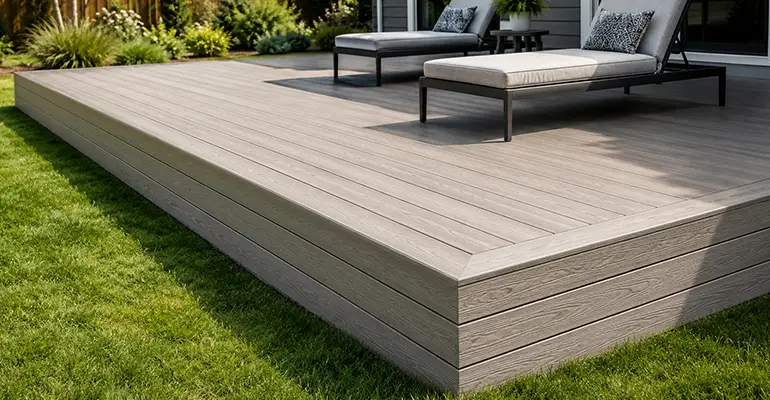
12. Low-Profile Composite Deck with Mitered Skirting Corners
The mitered corner is everything here. It’s a small detail that elevates the entire project from a standard deck build to a piece of custom craftsmanship. A simple butt joint, where one board’s end is pushed against the face of another, would look clunky and amateur. The 45-degree mitered cut allows the wood grain pattern of the composite boards to wrap around the corner seamlessly, creating the illusion of a solid, thick block of material. It’s this attention to detail that signals a high-quality, professional installation.
💸 Get This Look For Less
To achieve a perfect mitered corner with composite decking, which can expand and contract with temperature, don’t just glue and screw. Use a combination of a high-quality exterior construction adhesive and pocket holes drilled on the inside faces of the joint. Some manufacturers also offer specialized corner joining systems. Most importantly, cut both pieces from the same board if possible to ensure the color and grain pattern match perfectly, and ‘dry fit’ them together to check for a tight seam before applying any adhesive.
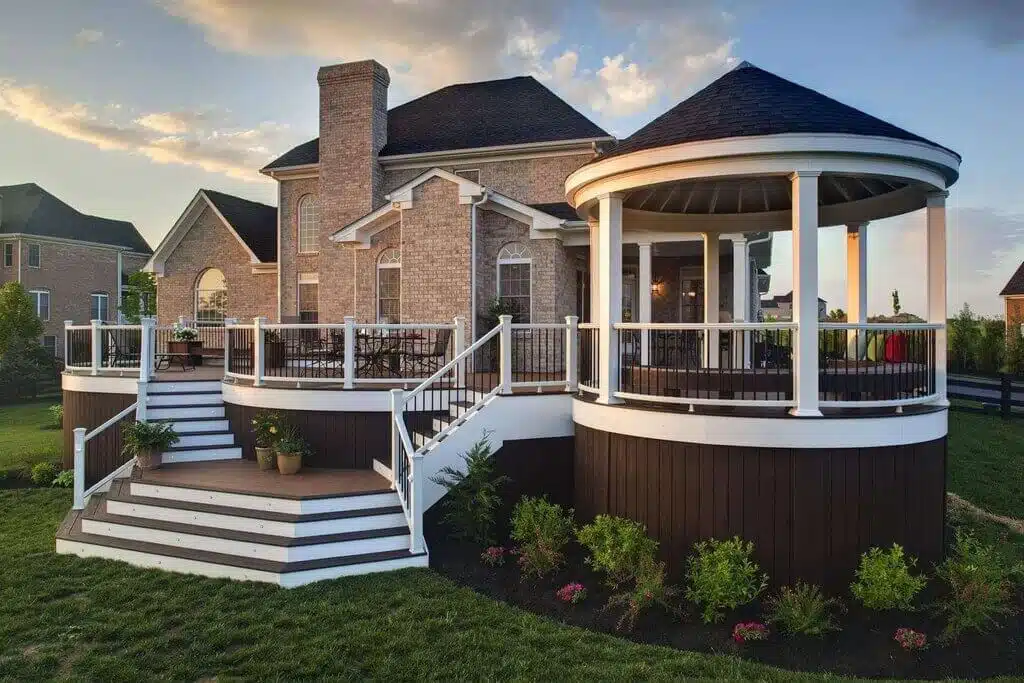
13. Dark Brown Vertical Skirting with a Crisp White Trim Band
This design uses a classic architectural trick: a strong horizontal line to unify a complex shape. The crisp white trim band that runs along the top of the dark skirting is the hero. It acts like a belt, visually cinching everything together—the straight sections, the stairs, and even the complicated curve of the gazebo. This white line connects directly to the white railings and stair risers, creating a cohesive and intentional color story. The dark vertical planks below ground the structure, while the white elements give it a light, traditional feel.
💡 Designer Tip
A vertical plank skirting is a great choice for tall or multi-level decks. Unlike horizontal slats, which can look ladder-like on a tall structure, the vertical lines draw the eye downward, visually connecting the deck to the ground and making it feel more stable and less imposing. This technique is especially effective for the curved section of the gazebo here, as narrow vertical boards can easily follow a curve that would be impossible for rigid horizontal planks. This approach is ideal for decks that are 3 to 8 feet off the ground.
14. Dark Lattice Skirting on a Multi-Toned Brown Composite Deck
That lush green shrubbery looks gorgeous against the dark lattice, but be prepared for a constant battle. Plants growing this close to a deck structure will trap moisture, block airflow, and provide a highway for insects. You’ll need to trim them back aggressively at least twice a year to maintain a 6-inch gap between the foliage and the skirting. This is crucial for allowing the area under the deck to dry out and for preventing wood rot on the deck’s framing. The plants look great, but they add a significant maintenance task to your list.

💰 Budget Breakdown
Using two different tones of composite decking—a lighter tan for the main surface and a medium brown for the frame and stairs—is a trend that’s been gaining steam. It adds custom-built character and helps define different zones, much like an area rug does indoors. Pairing this with a classic, affordable skirting material like dark lattice makes the overall project feel elevated without breaking the bank. It’s a smart mix of high-end trends (multi-toned composites) and budget-friendly staples (lattice), which is exactly how people are approaching home projects right now.
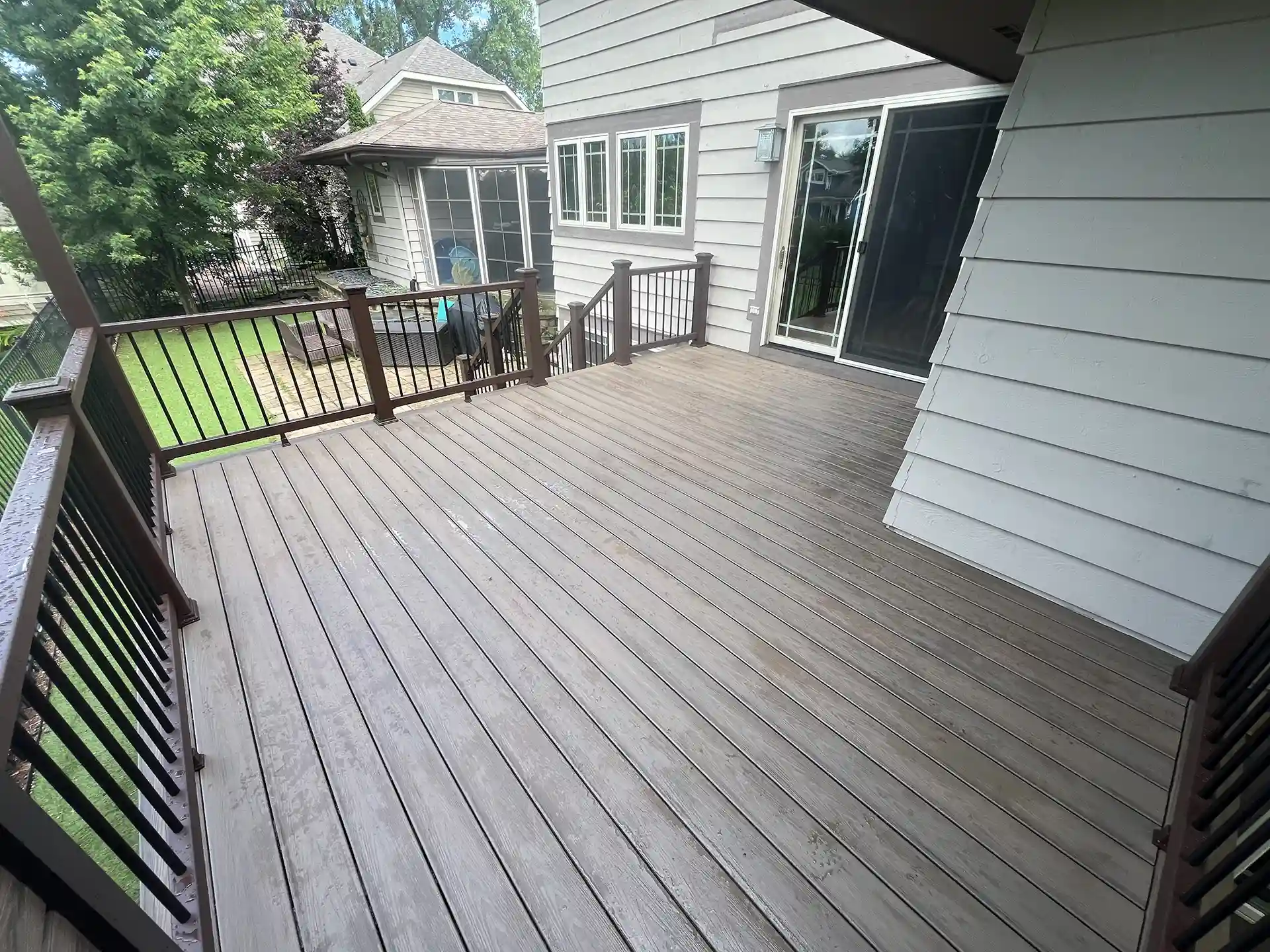
15. Multi-Level Composite Deck with an Open Under-Deck Space
Okay, let’s talk about the ‘no skirting’ look. While it can feel open and airy, it’s not for everyone. The underside of a deck is rarely pretty. You’re looking at pressure-treated lumber, support posts, and whatever the ground situation is—dirt, weeds, or maybe some forgotten gardening tools. This option only works if the view under the deck is unobjectionable, like a well-maintained lawn that slopes away gently. If the ground underneath is a mess, skipping the skirting will just make your whole yard look unfinished. It’s a bold choice that requires a tidy backdrop.
🔧 How-To Brief
The most important element of this ‘no-skirting’ design is actually the height. Because the deck is elevated significantly off the ground, the open space underneath doesn’t feel cramped or awkward. It creates a usable, sheltered area—a perfect spot for a hammock or a kids’ play zone. If this deck were only two feet high, the open space would just look like an unfinished gap. The generous clearance is what transforms the lack of skirting from a cost-saving omission into a deliberate design feature. This is the opposite of the low-profile deck in Idea #8, where full skirting is essential.
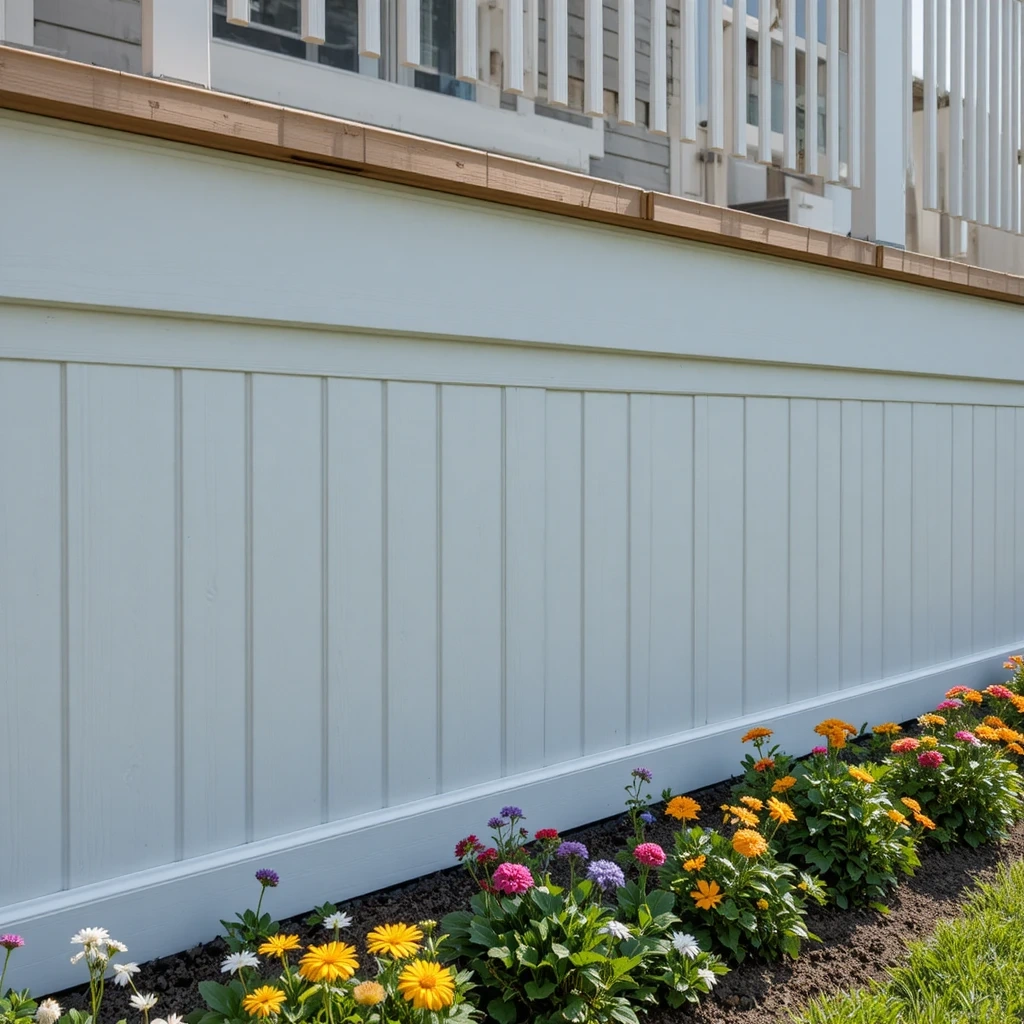
16. White Vertical Plank Skirting Framed by a Natural Wood Accent
This design feels so fresh and clean because of the thoughtful layering. The white vertical planks provide a bright, classic base. But it’s the narrow strip of natural wood above it that makes the whole thing pop. This thin line of warmth acts as a perfect transition between the white skirting and the white railing, preventing it from becoming a monolithic block of white. It’s a small detail that adds a touch of organic texture and sophistication, tying in beautifully with the vibrant flower bed in front.
⭐ The One Thing
The visual recipe is: 70% crisp white + 20% vibrant color + 10% natural wood. The vast majority of the structure is clean white, creating a bright backdrop. The flower bed provides a powerful punch of color and life, preventing the white from feeling sterile. The final 10% is that essential wood accent strip. It adds just enough warmth and natural material to keep the design feeling grounded and connected to the garden. You could swap the white for a soft grey and it would still work, as long as you keep that warm wood transition piece.
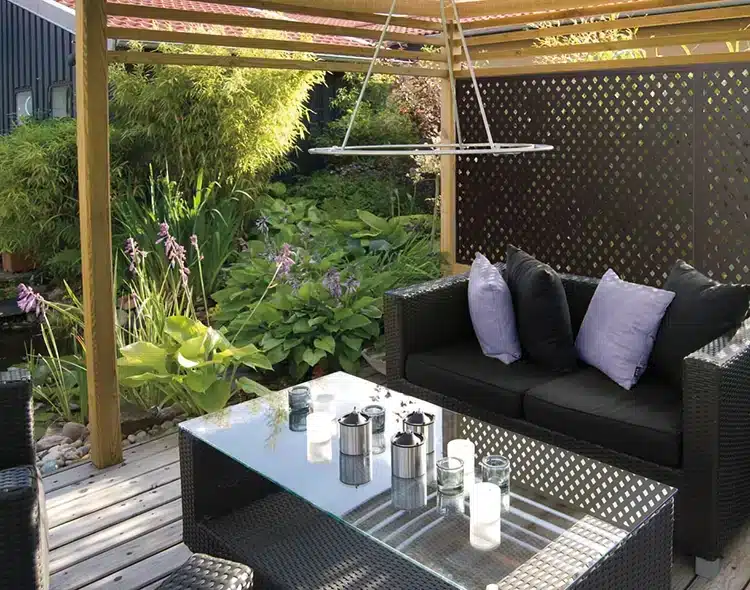
17. Weathered Deck with a Black Lattice Screen and Wicker Furniture
The key to this cozy, relaxed vibe is the dark backdrop provided by the lattice. You can achieve this look very affordably. Instead of expensive hardwood lattice, use standard pressure-treated diamond lattice panels from a place like Lowe’s or Home Depot (around $35 per 4’x8′ panel). Then, grab a can of black or dark brown solid exterior stain (about $50). Staining is better than painting because it soaks into the wood and won’t peel or chip like paint can. The result is a rich, dark screen that makes the green foliage and your furniture pop, just like in this high-end version.
🧹 Maintenance Reality
When using a lattice screen as a backdrop, ‘doubling up’ the panels can make a huge difference. By installing a second layer of lattice directly behind the first, but offsetting it by half a diamond, you create a much more substantial and private screen. It reduces visibility through the screen to almost zero, giving you a solid-feeling wall while still allowing for excellent airflow. This trick makes inexpensive lattice look much more custom and high-end, and it provides a better ‘canvas’ for your plants and furniture to stand out against.
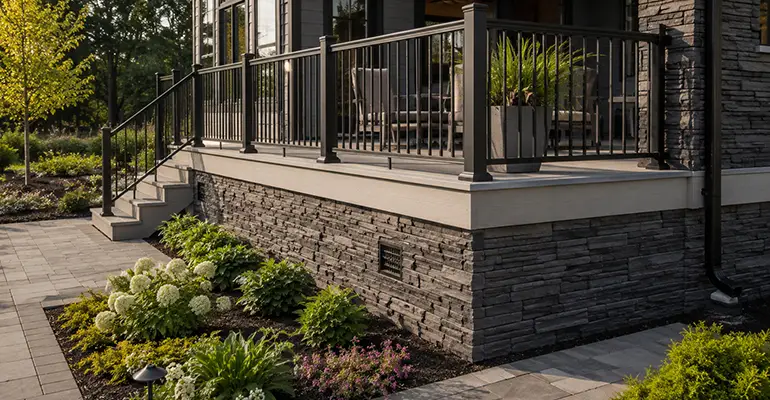
18. Dark Stacked Stone Skirting on a Greige Composite Deck
That beautiful, rough-textured stacked stone veneer can be a magnet for dirt, pollen, and even mildew in shady, damp areas. A yearly cleaning with a pressure washer on a wide-angle, low-pressure setting is a must to keep it looking sharp. For stubborn stains, a soft-bristle brush and a dedicated outdoor stone cleaner will do the trick. The greige composite decking is much lower maintenance—just a good scrub with soap and water is usually enough. But be aware that light colors like greige can show dirt and stains more readily than darker browns.
🎯 What Makes It Work
This is a fantastic example of mixing color temperatures for a sophisticated, modern look. The dark grey stacked stone is a cool, strong, earthy element. This is paired with a ‘greige’ (grey + beige) composite deck, which is a warm neutral. The black metal railing adds a third, sharp neutral. This careful balance of cool stone, warm decking, and neutral metal prevents the design from feeling one-note. It creates a dynamic, layered palette that feels both contemporary and timeless. A similar stone look with a different feel is seen in Idea #4.
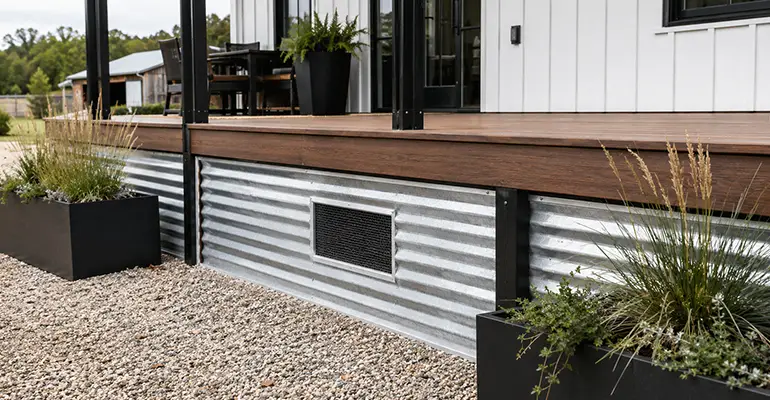
19. Corrugated Metal Deck Skirting with Black Planters
Installing corrugated metal skirting is a straightforward DIY. Here’s how:
- Build a Frame: Create a simple frame using 2×4 pressure-treated lumber between your deck’s support posts. This gives you a surface to attach the metal to.
- Cut the Panels: Measure the sections you need and cut the corrugated metal panels to size using an angle grinder with a metal-cutting wheel or a pair of tin snips. Always wear safety glasses and gloves!
- Pre-drill Holes: Pre-drill holes through the high points (the ‘ridges’) of the corrugation. Drilling in the ‘valleys’ can lead to leaks and rust.
- Attach the Panels: Secure the panels to your wood frame using roofing screws with neoprene washers. These screws create a waterproof seal at each attachment point.
Time: 4-6 hours. Cost: $200-$400 for an average-sized deck.
✅ Before You Start
Industrial-chic looks great, but let’s talk practicalities. Corrugated metal has sharp edges, especially after being cut. If you have kids or pets running around, you must ‘frame’ the top and bottom edges with wood or a metal trim piece to cover these hazards. Also, standard galvanized steel (like the one shown) will eventually rust, especially at cut edges or screw points. For a longer-lasting solution, consider Galvalume or powder-coated panels, though they are more expensive. Finally, that metal is going to get hot in direct sun, so be mindful if you have delicate plants right up against it.
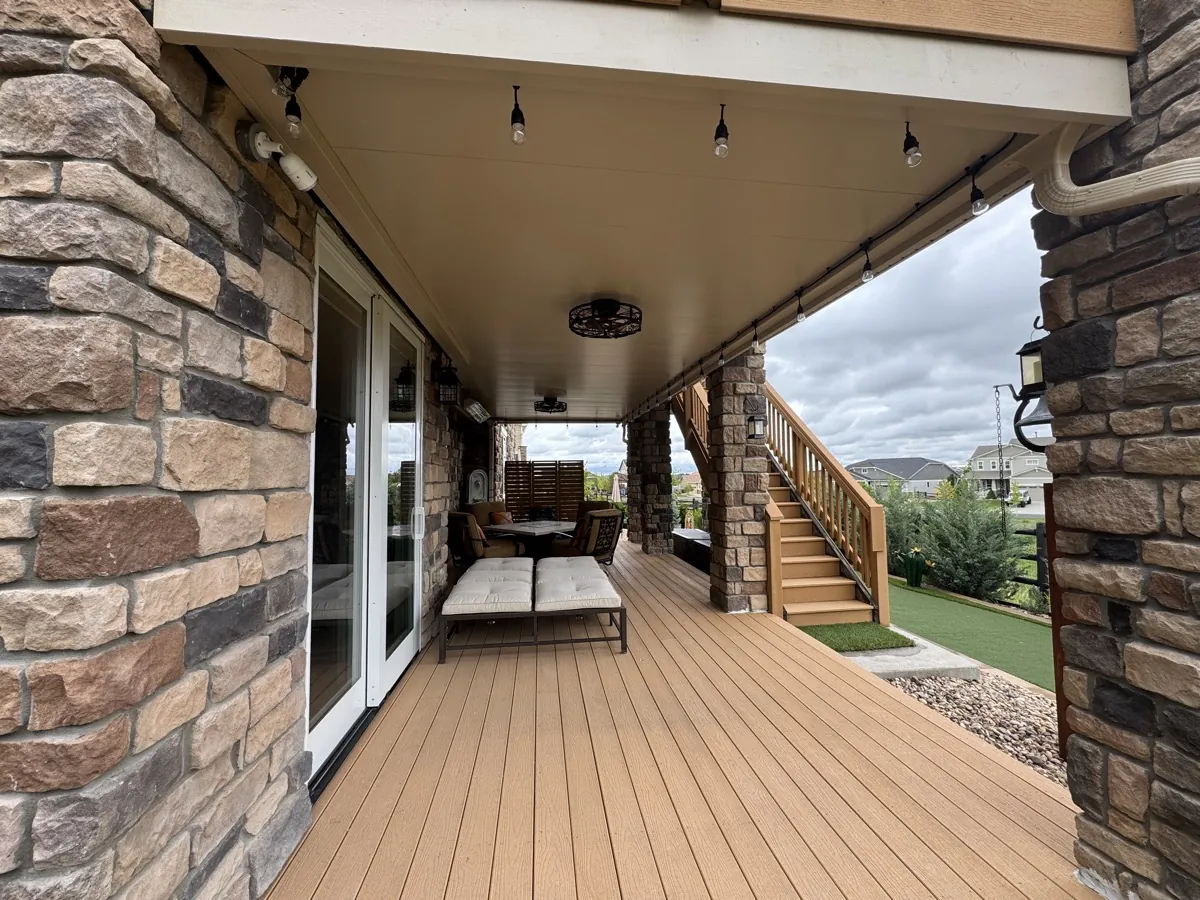
20. Clean and Simple Horizontal Slatted Wood Deck Skirting
The key to this look is consistency. It’s the perfectly uniform gap between each and every horizontal slat that creates such a pleasing, rhythmic pattern. If the gaps were uneven, the whole thing would look sloppy and DIY in a bad way. This precision elevates simple wood planks into a deliberate, architectural feature. It shows care and attention to detail, which is what separates a good project from a great one. The clean lines feel modern, airy, and intentional. A similar but more enclosed version can be seen in Idea #7.
🔥 Trending Context
You don’t need expensive cedar or Ipe to achieve this clean, modern look. A great budget-friendly option is to use standard pressure-treated 1×4 or 1×6 boards from any home improvement store. The trick is to take the time to sand them smooth and then apply a high-quality solid or semi-transparent exterior stain. A light natural stain can mimic cedar, or a solid gray stain can give you a trendy, weathered look. The material cost is low; the ‘expensive’ part is the time you invest in proper finishing.
21. Dark Teal Painted Deck with Natural Wood Lattice Skirting
If you’re going for a bold, saturated color on your deck like this dark teal, prep is everything. Do not skip the primer. Use a high-quality exterior primer designed for wood; it will help the paint adhere better and prevent tannins from the wood from bleeding through and staining your beautiful color. For the paint itself, choose a formula specifically designed for decks and porches. It will have better durability and often includes a non-slip texture. Expect to apply two full coats for a rich, even color like this.

📏 Scale Guide
The color combination is what makes this design sing. The deep, cool teal is a bold and unexpected choice for a deck, immediately giving it a custom personality. This is beautifully balanced by the natural wood color of the lattice skirting, top rail, and stair treads. The warmth of the wood prevents the teal from feeling too cold or overwhelming. It’s a classic pairing of a bold color with a warm neutral, creating a look that is vibrant and fun yet still feels grounded and connected to the outdoors.
22. White Horizontal Board Skirting with Exposed Support Posts
This look, with its visible support posts and horizontal skirting, is best suited for low-level decks no more than 3 feet high. The visible posts help break up the horizontal lines of the skirting, which is a good thing. On a very high deck, this many visible posts and the concrete footings could start to look busy and utilitarian. For a lower deck, it creates a clean, almost ‘post and beam’ architectural style that feels sturdy and well-constructed. It’s a great fit for cottage, farmhouse, or traditional home styles.
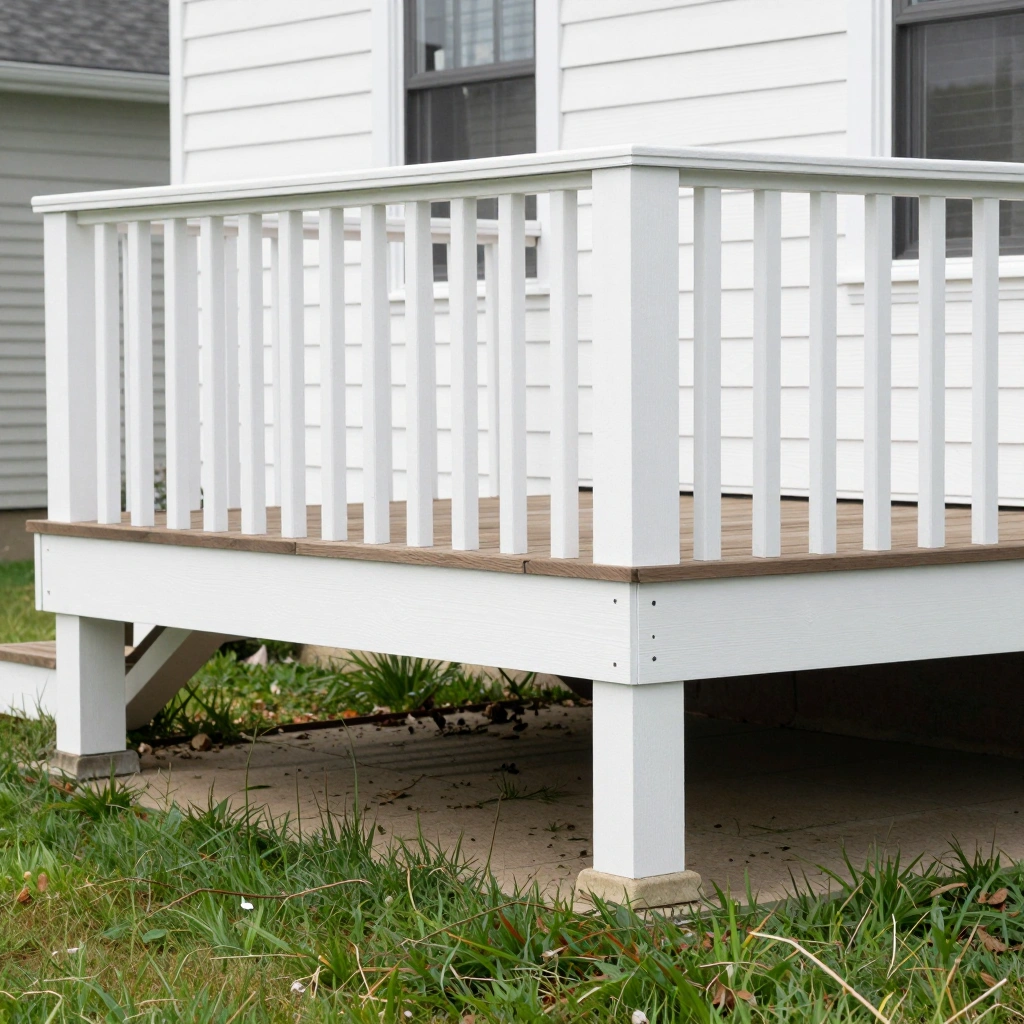
📐 Style Math
A white-painted deck skirt looks incredibly crisp and clean… when it’s clean. Being so close to the ground, it’s a magnet for dirt, mud splatter from rain, and grass clippings from the lawnmower. You will be cleaning this more often than you think. A pressure washer on a low setting will be your best friend. Also, any part of the wood that is close to or touching the concrete bases or ground is a prime spot for moisture wicking and paint peeling. Be prepared for yearly touch-ups in these areas to keep it looking sharp.
23. L-Shaped Slatted Wood Privacy Screen with Solar Lights
The solar post lights are the detail that elevates this from a simple privacy screen to a truly functional and atmospheric feature. During the day, they add a decorative, faceted finial to the posts. But at night, they cast a warm, ambient glow across the deck, providing just enough light for navigating the space and creating a cozy mood without the harshness of a floodlight. They add function and style with zero wiring and zero cost to operate, which is a huge win for any outdoor project.
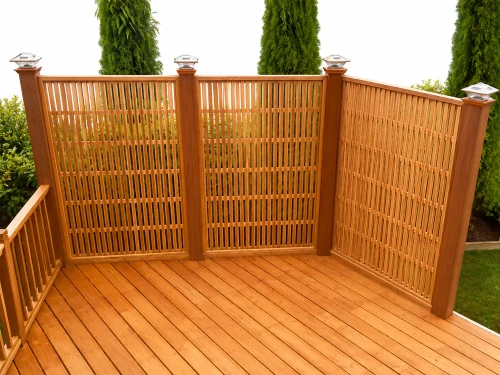
⚠️ Real Talk
As our lots get smaller and our neighbors get closer, privacy is becoming the ultimate outdoor luxury. That’s why features like this slatted privacy screen are exploding in popularity on Pinterest. People want to create intimate, room-like zones in their backyards. The semi-transparent nature of the vertical slats provides seclusion without making you feel completely boxed in. It blocks the direct line of sight from a neighbor’s window but still allows for airflow and a sense of openness, which is the perfect compromise for modern outdoor living.
24. Composite Skirting with Black Lattice Panels and an Integrated Gate
The cohesive material palette is key here. Using the same dark brown composite for the deck surface, the skirting frame, and the gate frame creates a unified, intentional look. The black lattice and black metal railings are used as consistent accents throughout. This limited, repeating palette of dark brown and black is what makes the whole structure, including the functional gate, feel like a single, well-designed piece. It’s a simple but effective strategy: pick two materials/colors and use them consistently for structure and accent.
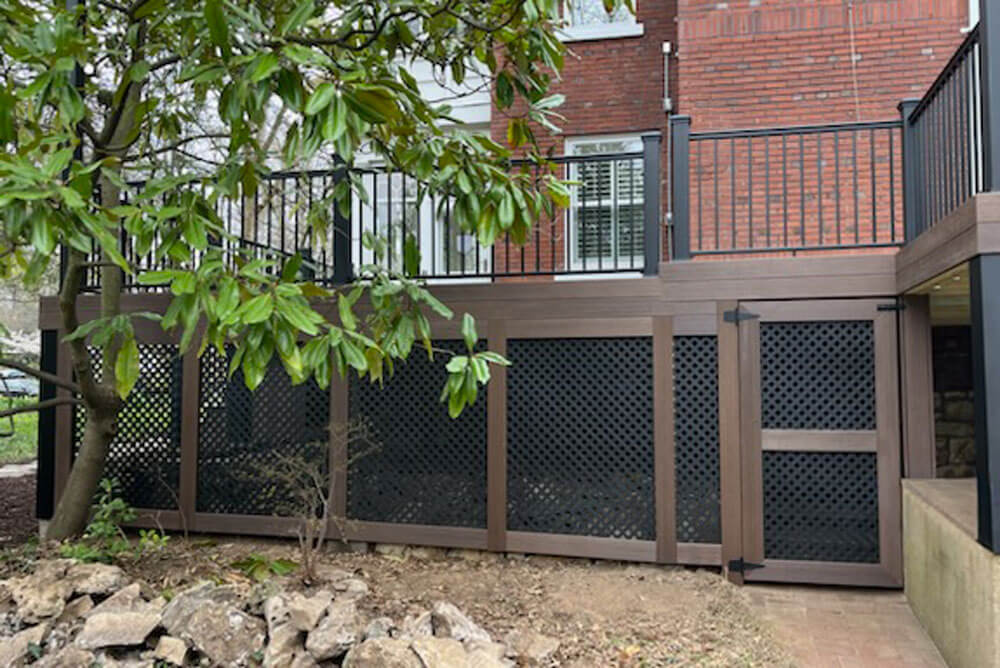
💸 Get This Look For Less
When building a gate into your deck skirting, sagging is the enemy. To prevent this, build the gate frame with mitered or half-lapped corners, reinforcing them with exterior-grade wood glue and screws. More importantly, install a diagonal cross-brace on the back of the gate. The brace should run from the bottom hinge corner up to the top latch corner. This simple piece of wood or metal cable transfers the weight of the gate back to the hinges, effectively preventing it from drooping over time. It’s an old carpenter’s trick that always works.
25. Simple Horizontal Natural Wood Slat Deck Skirting and Stairs
To get this straightforward, natural look on a tight budget, use standard pressure-treated deck boards (5/4″ x 6″) for the slats. They are inexpensive, readily available, and designed for outdoor use. To avoid the typical greenish-brown look, let the boards dry out for a few months after installation, then clean them with a deck cleaner and apply a semi-transparent stain in a warm cedar or redwood tone. This will give you the look of more expensive wood for a fraction of the cost, though you’ll need to reapply the stain every couple of years.
💡 Designer Tip
This simple, all-wood horizontal design is incredibly versatile, but it shines on small to medium-sized decks that are relatively low to the ground (under 4 feet). The continuous horizontal lines can help make a narrow deck feel wider. For a very large or tall deck, this uniform pattern could feel a bit monotonous. In that case, consider breaking it up by adding vertical trim boards at the corners or every 8 feet, creating a ‘paneled’ effect. This adds a bit of architectural detail and visual rhythm.
26. Multi-Level Deck with Black Lattice Skirting and a Stone Path
This expansive outdoor space works because it successfully blends the man-made structure with the natural landscape. The dark brown deck and black lattice skirting provide a clean, defined area for dining and lounging. This structure is then softened and integrated into the yard by the organic, curving shape of the stone pathway and the lush garden beds. The hard lines of the deck are balanced by the soft curves of the landscape, creating a harmonious transition from the house to the lawn. It feels like a complete outdoor room, not just a deck tacked onto a house.

💰 Budget Breakdown
The most important element here is scale. This is a large deck, and it’s paired with equally generous landscaping features—wide stairs, a substantial stone chimney, a meandering path, and large umbrellas. Everything is in proportion. A tiny, flimsy lattice skirt or a narrow path would look comical and out of place next to this big structure. The design succeeds because it embraces its large scale and uses appropriately sized elements throughout, creating a space that feels grand and inviting, not overwhelming.
27. Open Under-Deck with Visible Posts and Partial Dark Lattice
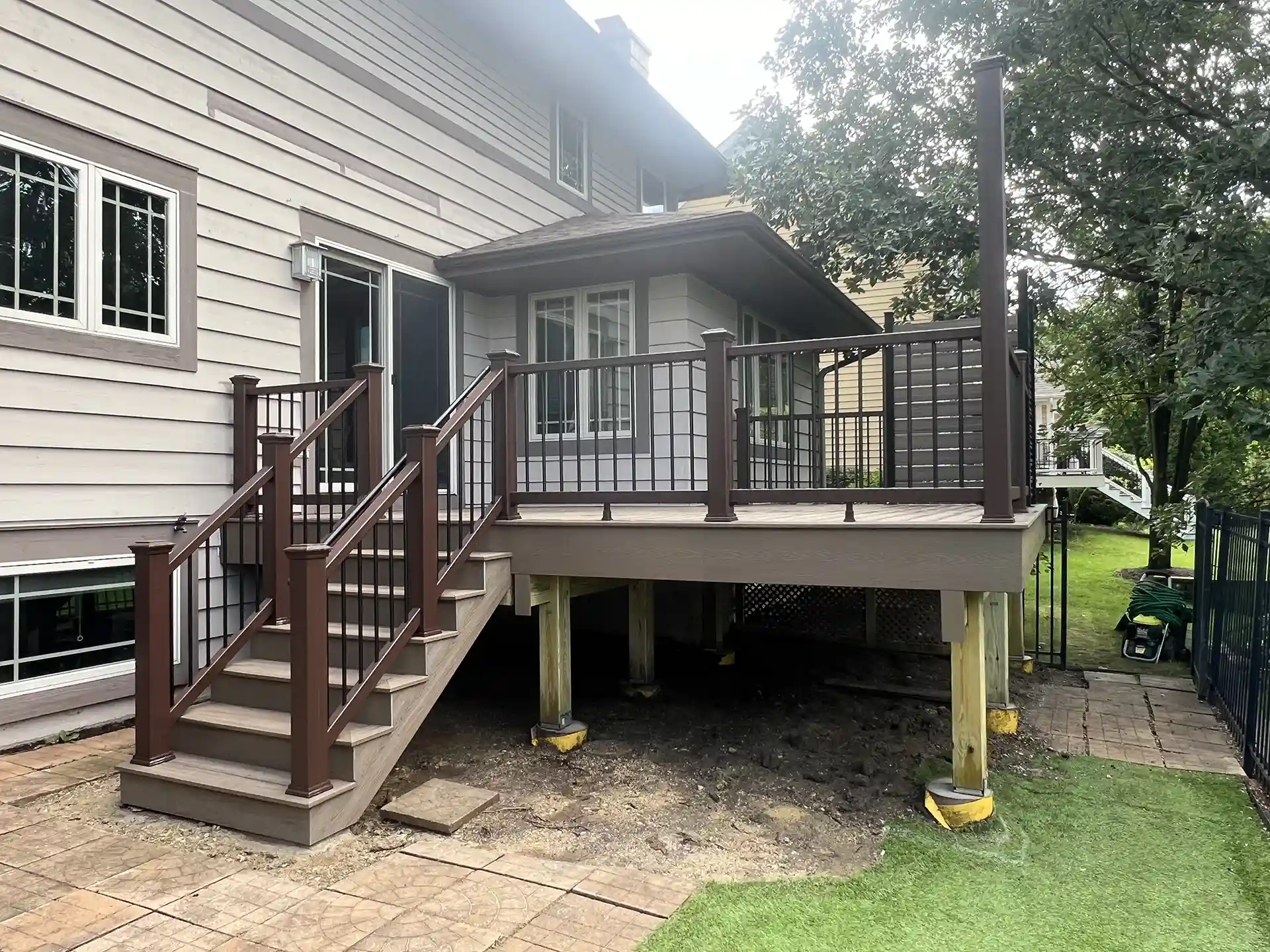
This photo is a perfect illustration of a project in progress, or one where the budget ran out. An open underside with exposed dirt and raw wood posts is rarely the intended final look. It collects leaves, becomes a mud pit in the rain, and is an open invitation for pests. The yellow bases on the posts suggest they may be post protectors, but the overall look is unfinished. If your deck looks like this, it’s a prime candidate for one of the skirting ideas in this article! Compare this to the finished look of Idea #14, which uses similar materials.
🔧 How-To Brief
If your deck is currently open underneath and you need a quick, cheap fix, lattice is your answer. You can buy 4×8-foot sheets of black or brown plastic lattice for about $40-$60 each. Simply cut them to fit between your deck’s support posts and attach them with screws. It won’t give you the high-end look of stone or horizontal slats, but for a few hundred dollars and a weekend of work, you can immediately conceal the unfinished space, provide ventilation, and make your entire backyard look 100% more put-together.
28. L-Shaped Horizontal Slat Privacy Screen on a Composite Deck
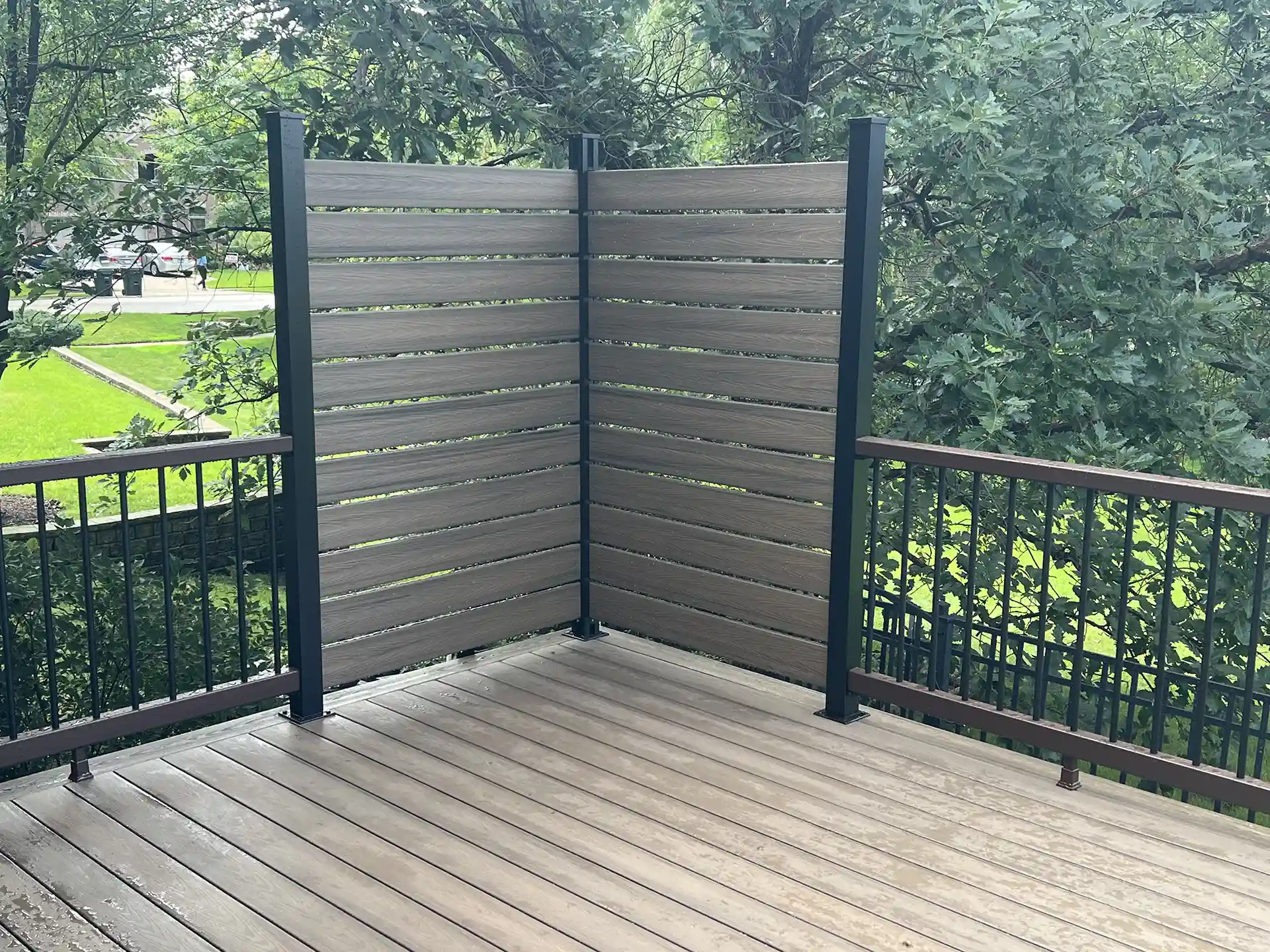
The visual formula for this modern look is: 60% light brown composite + 30% black metal + 10% dark brown accents. The light brown slats and decking create a warm, neutral field. The black metal posts of the privacy screen and the balusters of the railing provide a strong, graphic contrast, outlining the space with crisp, dark lines. The final 10% comes from the dark brown top rail, which adds a third color and a touch of richness, tying the whole scheme together. This is a classic contemporary palette that is both stylish and timeless.
⭐ The One Thing
For a horizontal slat screen like this, the spacing is everything. For a ‘semi-private’ feel that blocks views but allows light and air, use a spacer block that is the same thickness as your slat boards. For example, if you’re using standard 1-inch thick boards, use a 1-inch spacer. For more privacy, reduce the gap to 1/2 or 1/4 inch. The key is to use a physical spacer block as you install each board to guarantee a perfectly consistent gap from top to bottom. It’s the secret to a professional result.
29. Dark Solid Panel Skirting with a Light Wood Slatted Deck
The power of this design comes from its bold contrast. The solid, dark skirting creates a heavy, grounded base, almost like a foundation wall. Floating above this dark base is the light, airy surface of the natural wood slatted deck. The visual tension between the heavy, dark bottom and the light, bright top is what makes it so striking. This is further enhanced by the contrast with the bright white pergola and the vibrant red wall, creating a multi-layered composition of color and weight.

🧹 Maintenance Reality
Solid panel skirting like this provides excellent concealment, but it can severely restrict airflow under the deck. This is a major risk for mold, mildew, and wood rot on your deck’s substructure. It’s absolutely critical to install ventilation grates, ideally on at least two opposite sides, to encourage cross-ventilation. You can find paintable vent covers at any hardware store. Aim for at least 1 square foot of vent opening for every 150 square feet of deck area. Without proper ventilation, you’re creating a perfect environment for expensive problems down the road.
30. Deck Skirted with a Dark Geometric Lattice Privacy Screen
It’s the geometric privacy screens. They do double duty, acting as both skirting and a privacy wall, creating a true outdoor room. Unlike traditional diamond lattice, this modern, geometric pattern feels more like a decorative architectural element. It provides privacy and defines the space without feeling like a heavy fence. The dark color makes it recede visually, allowing the bright yellow umbrella and the green foliage to take center stage. It’s the perfect backdrop for creating an intimate and stylish outdoor living area.

🎯 What Makes It Work
This look is a direct response to the ‘outdoor room’ trend. People want their patios and decks to function like their living rooms, and that means defining the space and creating a sense of enclosure and privacy. These decorative panels, often available as easy-to-install kits from brands like Barrette Outdoor Living, are a modern, stylish way to achieve that. They’re more design-forward than traditional lattice and less imposing than a solid fence, hitting a sweet spot that’s perfect for creating a chic, secluded backyard oasis.
31. Light Beige Horizontal Panel Privacy Screen on a Wood Deck
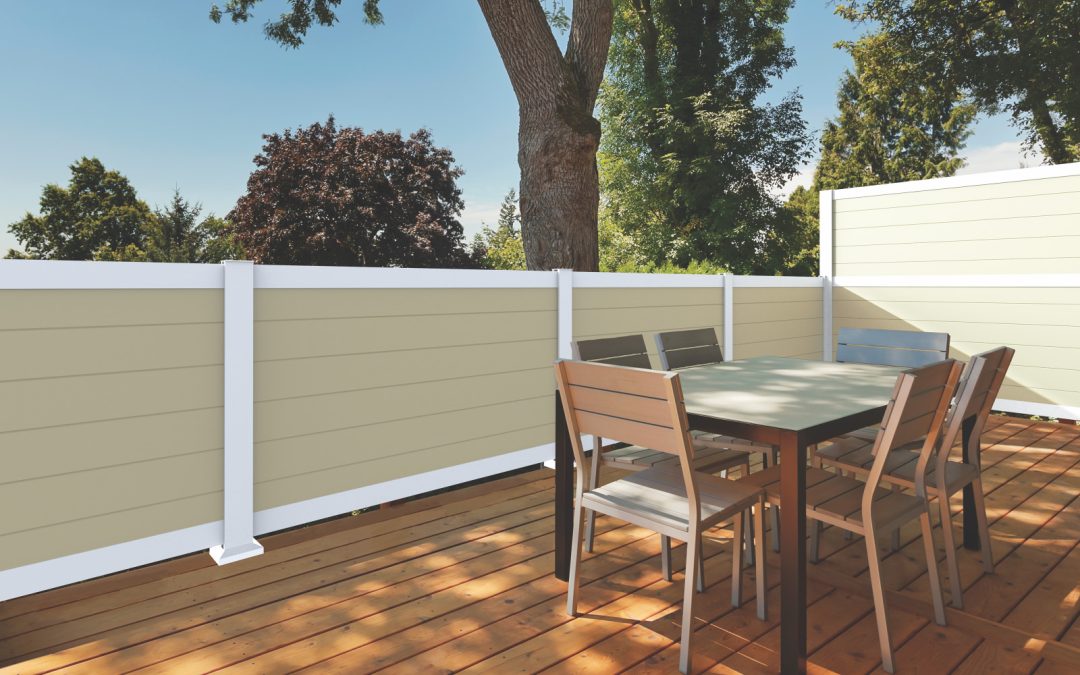
The formula here is all about bright neutrals: 50% warm wood + 30% crisp white + 20% soft beige. The natural light brown wood deck provides a warm, organic base. The white posts and rails create a clean, sharp frame that makes everything feel bright and structured. The light beige horizontal panels fill in this frame, adding a third neutral tone that is soft and sophisticated. This layered neutral palette creates a calm, airy, and upscale feel, perfect for a relaxing outdoor dining space. A pop of green from surrounding trees keeps it from feeling washed out.
✅ Before You Start
A privacy screen made of light-colored panels like this looks fantastic, but it will show every speck of dirt, pollen, and mildew. That bright white and beige will need a good scrubbing with a soft brush and an outdoor cleaner at least once or twice a year to stay looking fresh. Also, be mindful of what’s on the other side. If you have a messy neighbor or a lot of falling leaves, you might be cleaning this more often than you’d like. Darker colors are definitely more forgiving when it comes to daily dirt and grime.
32. Gray Composite Deck with Dark Lattice Inserts in the Skirting
This design cleverly combines the best of both solid and lattice skirting. The solid dark gray composite panels provide a clean, modern, and substantial look, perfectly matching the deck surface for a cohesive feel. But instead of creating a solid wall that would block all airflow, it incorporates dark diamond lattice inserts. This provides the necessary ventilation to keep the under-deck area dry while adding a touch of classic texture. It’s a smart hybrid approach that delivers both modern style and practical function.

🔥 Trending Context
When creating framed inserts like this, the trick is to mount the lattice to the back of the frame, not the front. Build your gray composite frame first. Then, from behind, place your cut-to-size lattice panel into the opening and secure it with small screws or staples. This technique, called ‘insetting,’ recesses the lattice slightly and completely hides its cut edges, giving you a much cleaner and more professional finish than if you had simply attached it to the face of the frame. It’s a small detail that makes a big impact.
The Finishing Touch Your Deck Deserves
As you can see, deck skirting is so much more than just a way to hide some storage bins. It’s the architectural detail that can tie your entire outdoor space together, adding polish, style, and a ton of curb appeal. Whether you go for rustic stone, modern slats, or classic lattice, the right choice will make your deck feel complete.
Ready to get started? Pick your favorite look, save this guide to your Pinterest board, and start planning. That finished, polished deck you’ve been dreaming of is closer than you think.