32 Jaw-Dropping Outdoor Christmas Light Ideas for 2026 That Will Make Your Home Shine

Still saving photos of outdoor Christmas lights 2026 without knowing which look will actually work on your house? We get it — the options are endless, and the stakes feel high when the whole neighborhood gets a front-row seat.
We spent serious time browsing Amazon, Home Depot, Target, and Lowe’s to pull only what’s worth your attention this year. The curated ideas ahead range from about $18 to $650, so there’s a display for every budget and lot size.
You’ll find 32 outdoor Christmas light ideas in total, spanning classic warm white rooflines, maximalist front yards, Victorian snow scenes, and modern color-blocked facades. We compare budget and luxury versions side by side so you can steal the look without blowing the season’s budget.
In 2026, the big shift is away from random lawn clutter and toward layered, intentional lighting — color stories, reflections, and projection accents. And stay until the end — we break down the most common mistakes that can ruin these looks.
📌 Save this to Pinterest for later — you’ll want to revisit these ideas.
1. Warm White Roofline Glow on a Traditional Stucco House
When you’re tracing a traditional roofline, don’t clip lights directly to gutters with cheap plastic hooks — they shift in wind and scratch paint. Use stainless steel shingle clips every 12 to 18 inches and choose C9 bulbs with a warm 2200K to 2400K tone. The warm cast here flatters tan stucco far better than daylight white, which can look blue against beige. Run one continuous strand from the main gable down to the dormer instead of connecting multiple short sections; fewer joins means fewer failure points in January cold.
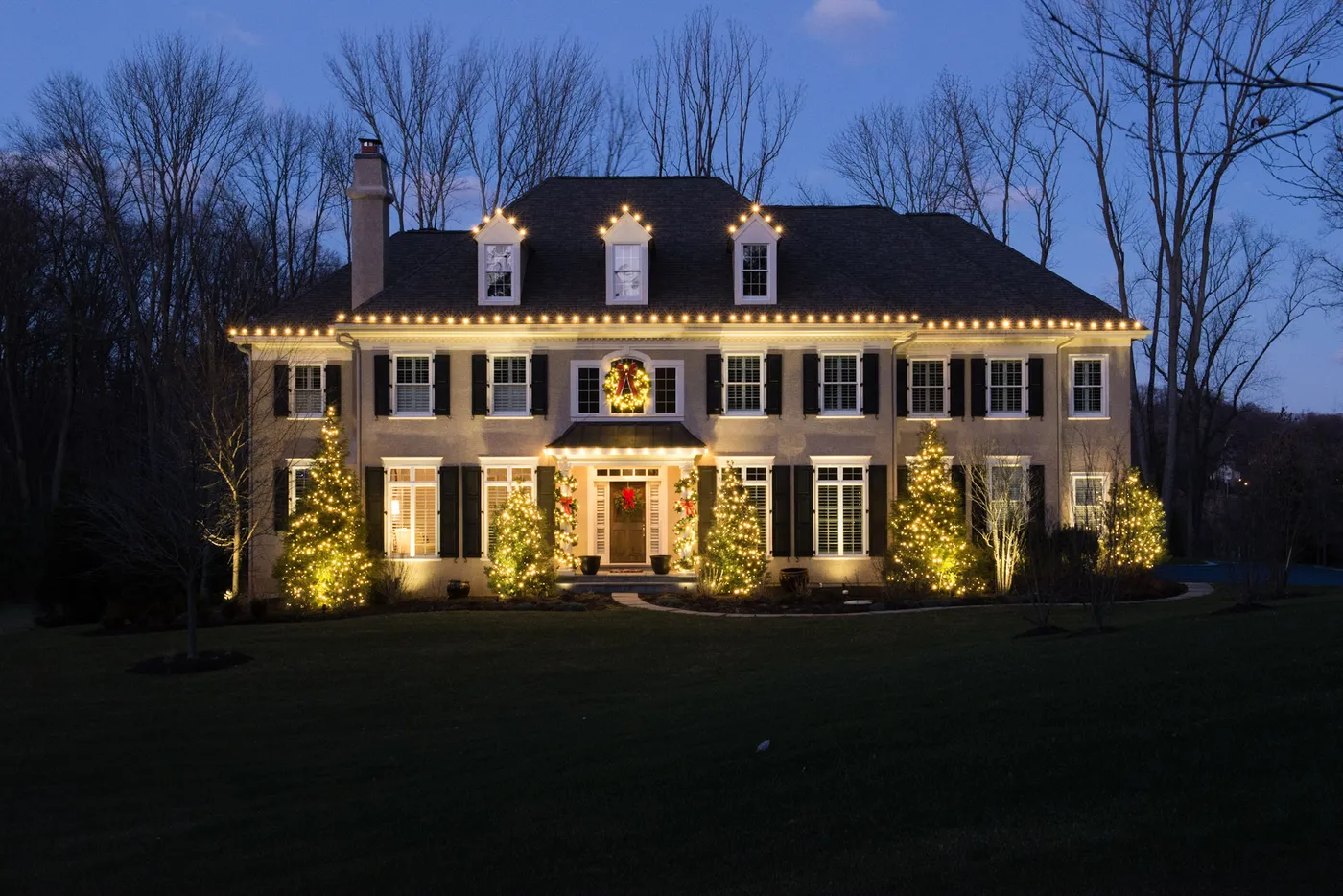
The red bow on that oversized wreath is doing a lot of heavy lifting. Against a field of warm white and dark shutters, a single saturated red accent acts like a punctuation mark. The repeated evergreen trees in the foreground also keep the scene from reading as a flat outline — they add depth and make the house feel nestled in the landscape rather than just decorated from the outside in.
2. Snowy Victorian Facade with Hanging Light Spheres and Colorful Fence Lines
The hanging light spheres strung through bare branches are what separates this Victorian from a standard roofline job. Without them, the snowy yard would still be pretty but far more static. Those spheres create a floating, almost enchanted layer between the house and fence line, pulling your eye around the whole property instead of stopping at the front door.
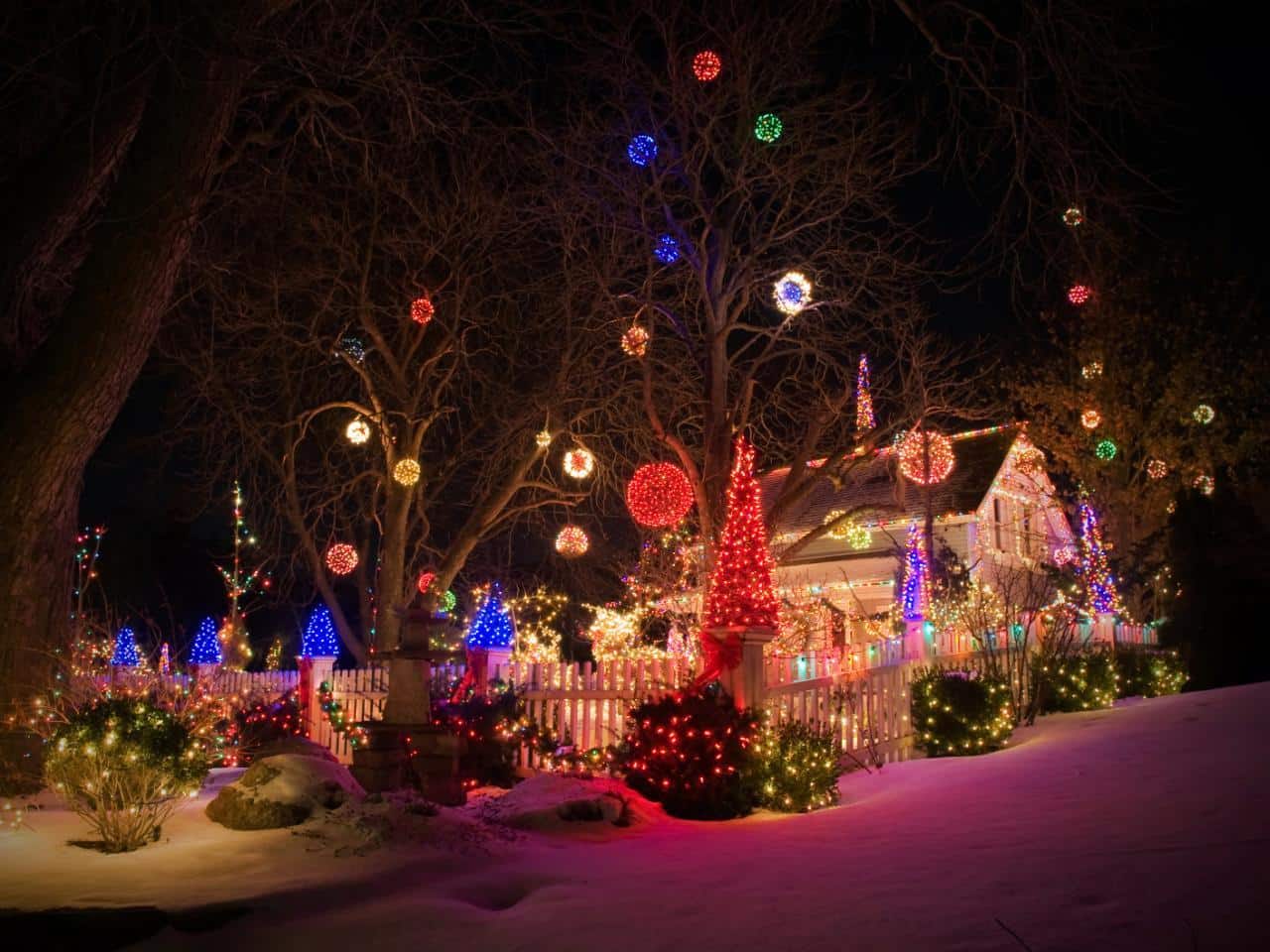
This look is growing on Pinterest because it leans into the 2026 move toward vertical layering — not just lighting the house shell, but lighting the air around it. Hanging orbs and pendant-style outdoor lights show up everywhere from holiday displays to summer patios. The trick is choosing weatherproof spheres rated for damp locations and spacing them at different heights so they feel organic, not like a grid.
3. Modern Farmhouse Icicle Lights with a Red, White, and Blue Candy Cane Arch
- Warm white icicle lights for rooflines and columns: $60–$140
- Lighted deer set of three: $80–$220
- Glowing snowman figure: $45–$120
- Candy cane arch kit: $50–$110
- Poinsettias and path markers: $35–$90
- Total: $270–$680
- Budget alternative: $150–$320 with used deer and a DIY arch.
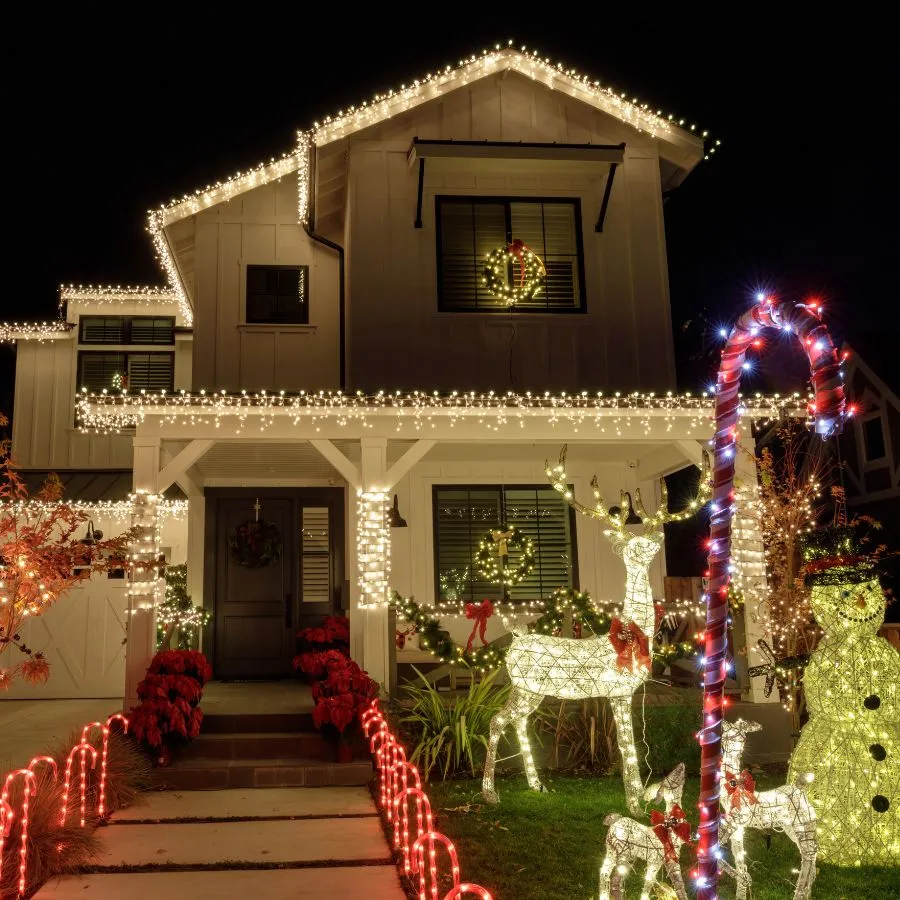
This modern farmhouse is essentially 70% warm white, 20% true red, and 10% blue accents. Stick to that formula and you can swap the candy cane arch for a red-and-white porch garland without losing the look. The poinsettias ground the red at eye level, while the blue in the arch keeps it from feeling too candy-shop. Compare with Idea #8 if you prefer a more restrained stone-and-brick entry.
4. Full-Landscape Color Drenching with Wrapped Trees and Reflective Ground
This is not a weekend project. Wrapping every tree and building on a large property takes serious planning, not just a few extension cords. You need a dedicated outdoor circuit or two, and you should map your amp load before adding another strand. The wet ground that makes this display look magical also raises the stakes for weatherproof connections and ground-fault protection. If your panel is already maxed, start with the building outlines and add tree wraps next year.
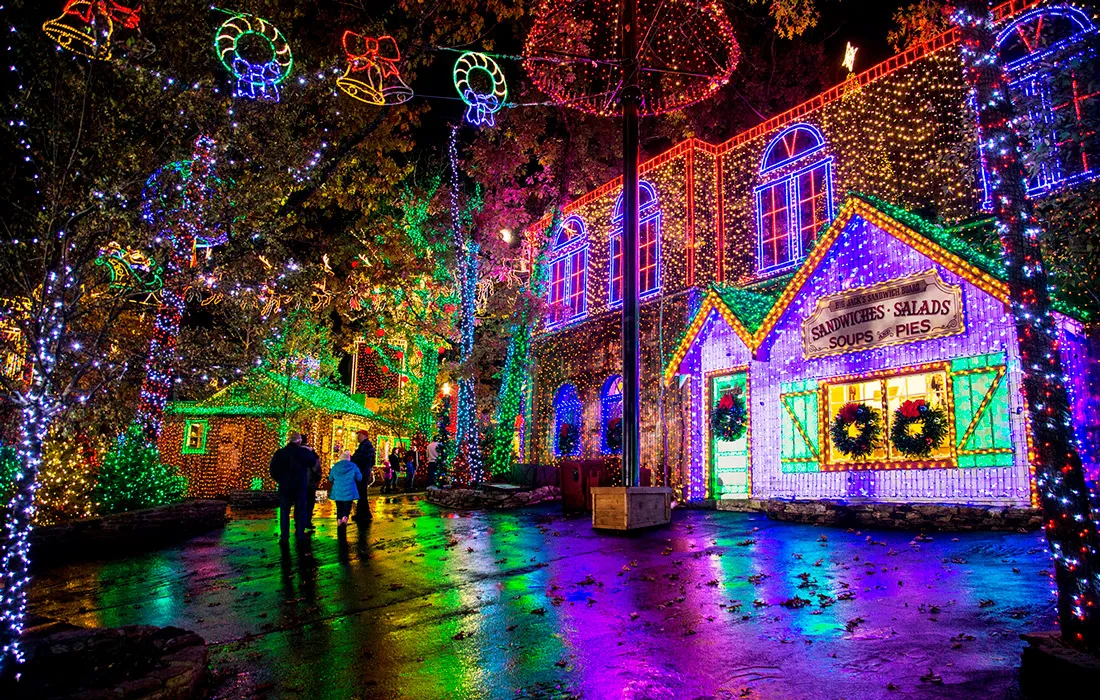
This full-landscape approach wants a minimum of about 8,000 square feet of visible property, ideally with mature trees at different depths. On a typical 50-foot suburban lot, the same effect would feel dense and chaotic rather than dazzling. If you have a smaller yard, take the overall idea and compress it: one building facade, two wrapped trees, and a reflective path surface will still give you that color-drenched feeling without overwhelming the space. Idea #13 shows a tighter patterned version.
5. Blue-Purple Castle Scene with Spiky Star Lanterns and White-Lit Trees
- Buy or bend three wire rings per star lantern, about 14, 20, and 26 inches.
- Wrap each ring with cool white fairy lights and zip-tie them into a spiky star shape.
- Hang lanterns from bare branches with clear fishing line at staggered heights.
- Set a blue-purple flood light low behind a tree trunk to wash the ground.
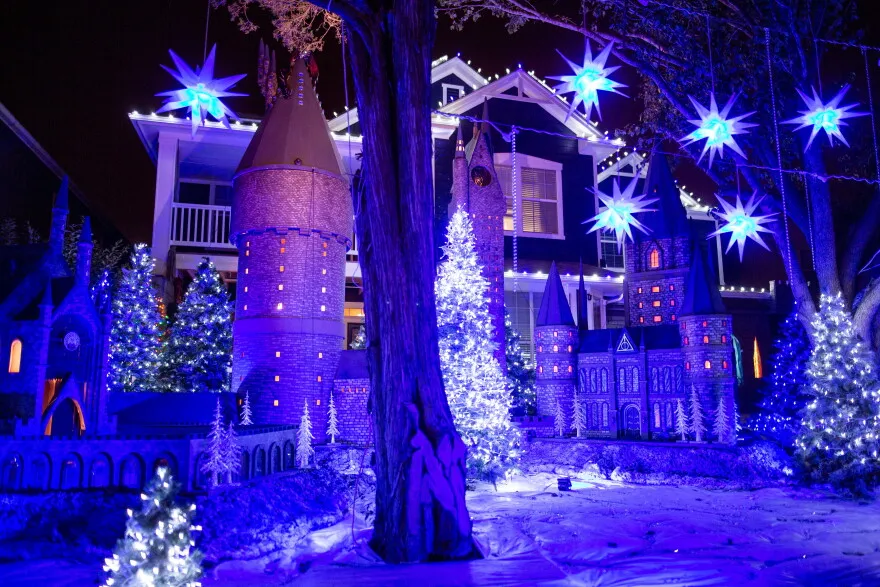
Plan on about two hours and $40–$70 for three lanterns.
The ground-level blue-purple wash is what turns a pretty light display into a full scene. Without that low glow, the miniature castle and trees would seem to float in the dark. It gives the entire yard a stage-like base that makes the white-lit trees feel taller and the shadows feel intentional.
6. Southwestern Roofline with Palm Trunk Wraps and Glowing Lawn Figures
Palm trunk wraps look fantastic, but expect to re-secure them after high winds, especially in southwestern monsoon or Santa Ana seasons. Use wide plastic zip ties rather than nails or staples, and leave a little slack for the trunk to expand in warm winter spells. Rope light around the garage also holds heat against stucco, so check for discoloration every year. Budget about $40–$80 annually for replacement clips and a few strands that inevitably fail.
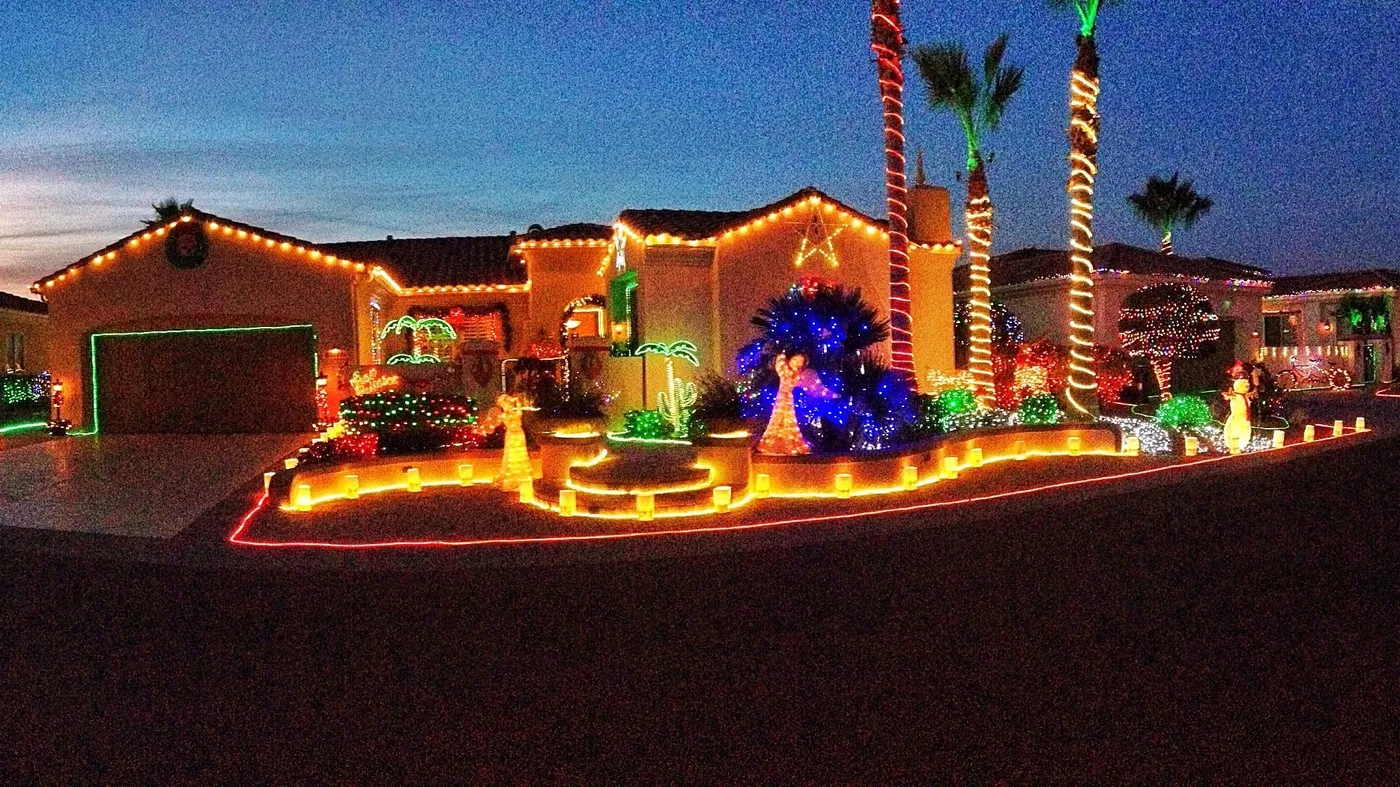
You don’t need a custom install to get this look. Start with a $50 set of green rope lights for the garage outline and a $35 multicolor net light set for shrubs. Add two prelit palm tree wraps from Home Depot or Amazon for about $60 each, then place a few $25 glowing snowman figures in the beds. That lands under $250 and still gives the same Southwestern festive energy.
7. Maximalist Inflatable Yard with Dense Multicolor Roofline Strands
The dense multicolor strands on the roofline set the frame, while the inflatable characters create repeated focal points at different heights. Because the house and trees are so heavily wrapped, the inflatables don’t look like clutter — they read as part of a larger, deliberately over-the-top scene. Repetition is the unsung hero here: every tree, bush, and figure is packed tightly, which turns an overwhelming display into a cohesive maximalist statement.
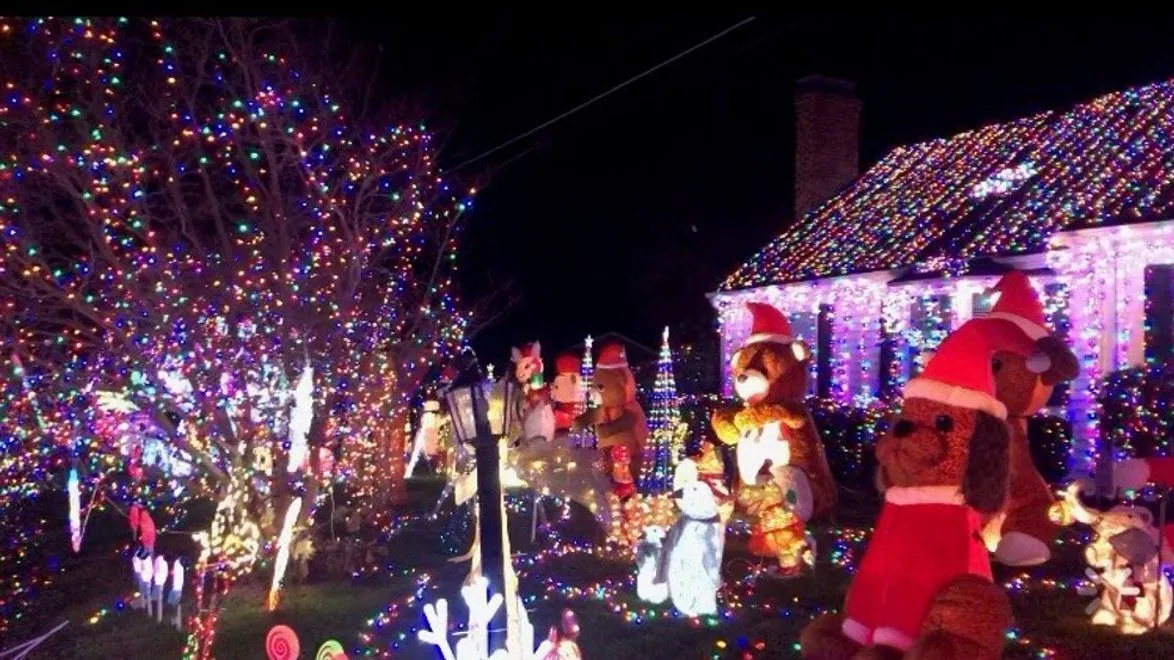
Inflatable characters need constant power and a place to live for eleven months. They also fold strangely if one fan fails, and they can trigger motion-sensor cameras at 2 a.m. If you go this route, buy a storage bin per character and label the cords like a sane person. The electricity cost is modest, but the visual commitment is not for minimalists or anyone with a strict HOA.
8. Warm White Roofline on Brick and Stone with Cone-Shaped Entry Trees
For brick and stone, skip adhesive clips that can pull off mortar. Use stainless steel shingle tabs or clip-on brick hooks designed for seasonal lighting, placed every 12 inches along gables. Run your warm white C7 strands in a continuous warm 2200K tone and keep them off the stone base, where moisture and de-icing salts can cause corrosion. The result should trace the architecture, not fight it.
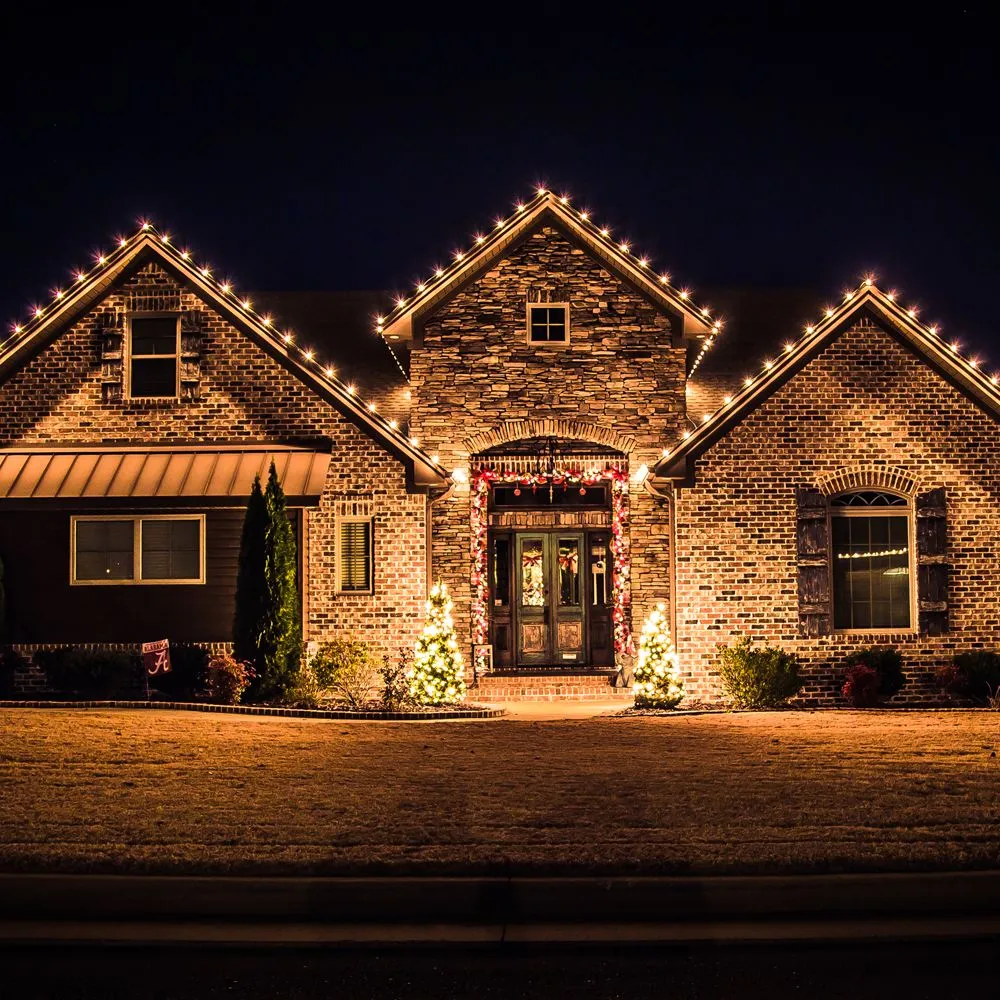
The stone and brick surfaces are durable, but the garland around the arched entry needs fresh zip ties every season. Pine garland sheds, especially near a warm exterior fixture, so vacuum or sweep the alcove before guests arrive. The cone trees flanking the door should be stored upright in a dry spot, because bent frames create permanent odd shapes after one winter in a damp shed.
9. Purple and Green Pathway Lighting with a Golden Tree and Striped Tent
- Purple LED string lights for pathway trees: $70–$150
- Green string lights for potted trees and bushes: $40–$90
- Large golden Christmas tree with stand: $90–$250
- Blue and purple striped tent or backdrop frame: $60–$180
- Total: $260–$670
- Budget alternative: $160–$330 with net lights and a secondhand faux tree.
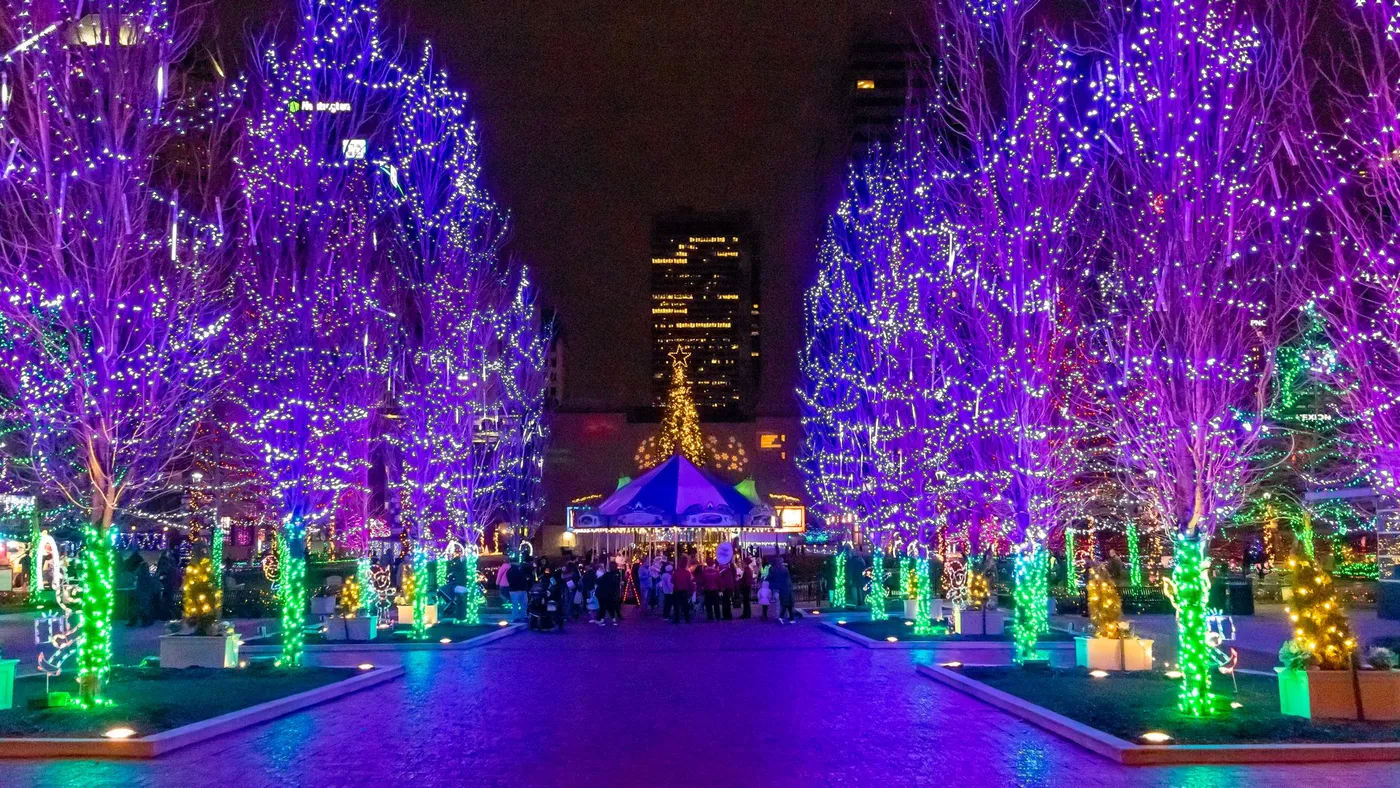
This path has a market-like energy because of the color blocking: purple trees on one rhythm, green shrubs on another, and a golden anchor at the end. It ties into the 2026 trend of using outdoor lighting to create distinct zones, not just a single wash of holiday color. Think of your walkway as a retail display — you want people to move through slowly, pause at the golden tree, and take a photo. Compare with Idea #13 if you want patterned ground lighting on a larger scale.
10. Christmas Market Projection Magic with Golden String Lights and Cobblestone
The visual formula here is about 50% warm golden string lights, 30% architectural projection, and 20% illuminated evergreen trees. Swap the projection for a snowfall gobo on a smaller house and keep the same golden-to-dark ratio. The cobblestone ground matters because it reflects just enough light to avoid a black hole effect while letting the building stand out.
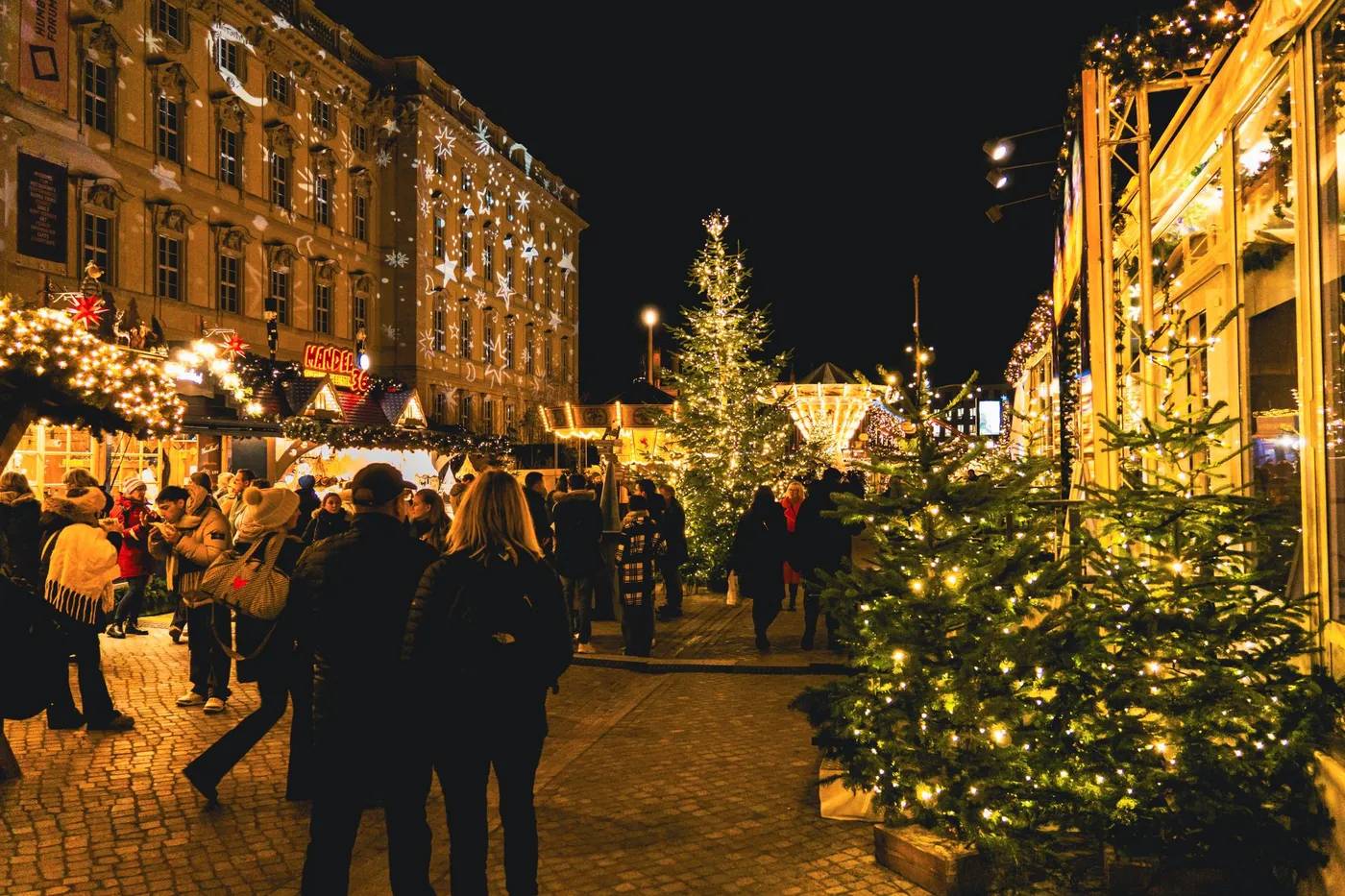
This works best in a space where people gather, like a wide front plaza, a courtyard, or a large driveway turned social zone. You need room for movement and enough vertical surface to catch the projections. For a typical single-family home, a carousel-sized projection will overwhelm the facade; instead, use one star or snowflake pattern on a gable and save the full market experience for a block party or backyard event.
11. Lodge-Style Multi-Gable Home with Warm White Roofline and Ground Stake Lights
- Measure your path edges and mark stake light placement every 3 feet.
- Choose warm white solar or low-voltage mini stakes with a 2200K cast.
- Push stakes into soil or along concrete-to-garden bed seams, never into lawn where mower blades hit.
- Run the low-voltage cable under mulch and test the transformer load before burying.
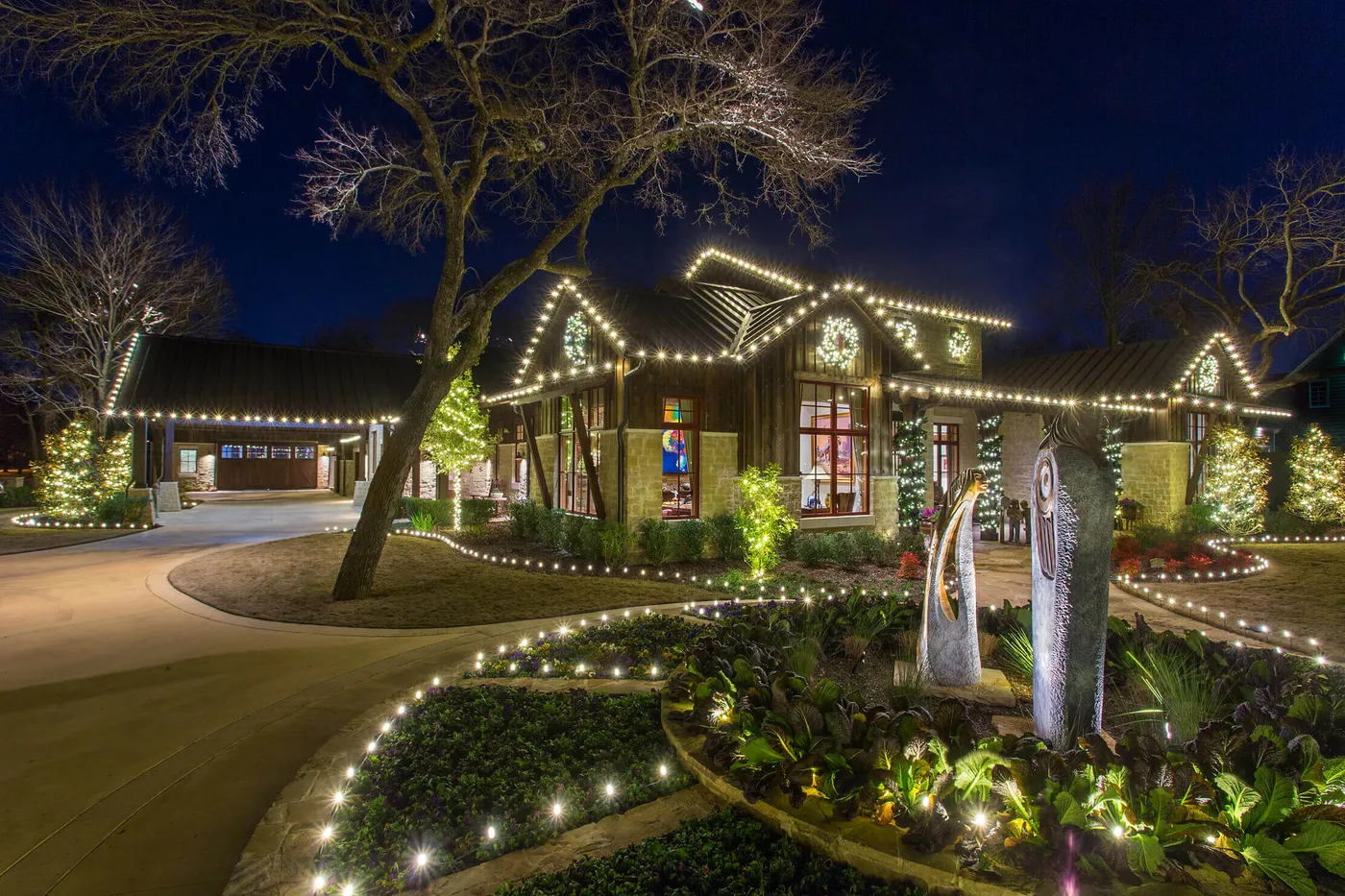
Plan for about three hours and $80–$160 depending on path length.
The ground-level stake lights are the quiet hero. They define the walkway and make the dark wood siding feel warmer and more approachable. Remove them and the house becomes a glowing outline floating above a black yard. That low layer of light is what makes the whole entrance feel safe and considered.
12. Brick House with Green Shrub Lights and Red Bare Tree Branches
- Measure the height and spread of your bare tree before buying red strands — you’ll need about 100 lights per 1.5 feet of branch length.
- Confirm you have a grounded outdoor outlet or low-voltage transformer within 25 feet of the trunk.
- Check your HOA rules if the red and green display is visible from the street.
- Test all strands before wrapping; red LED can look uneven if one section fails.
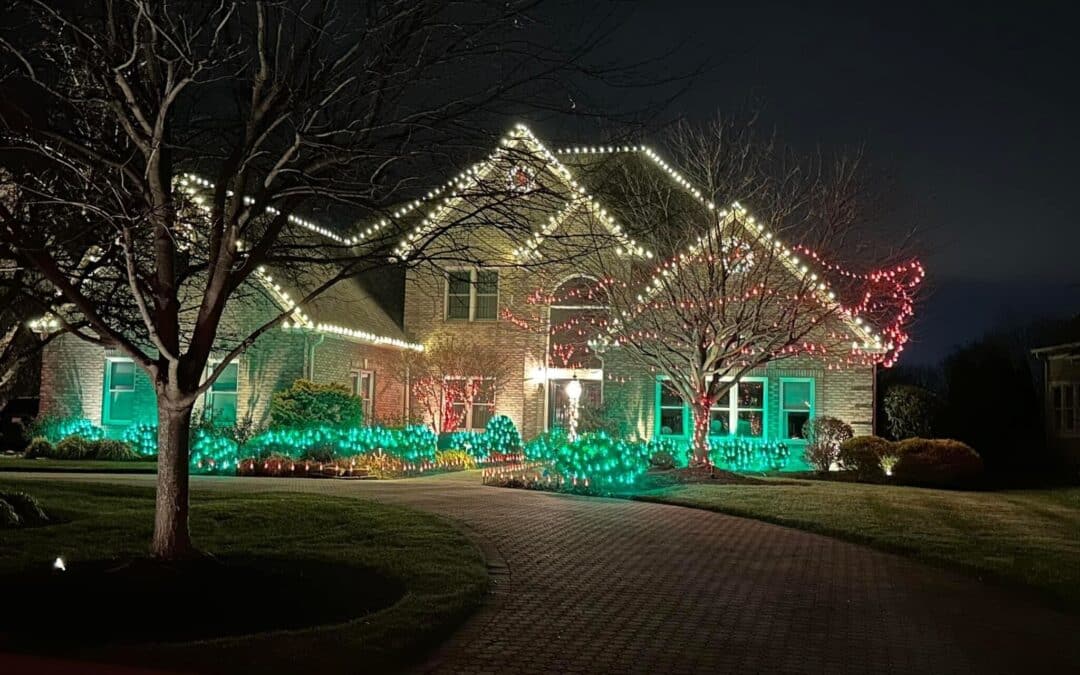
The brick facade gives a dark, earthy background that makes both the green shrub lights and red branch lights pop. The warm white roofline stays neutral, so the green and red read as intentional accents rather than random color. This is a classic holiday color story because the dark brick absorbs light, creating contrast instead of reflecting everything into a blur.
13. Patterned Ground Lighting in Blue, Green, and Pink Across a Garden Landscape
Patterned ground lighting doesn’t require an expensive permanent system. Use three $25 LED flood lights with blue, green, and pink gel filters aimed across the lawn, hedges, or stone wall. Mask off sections with plywood or cardboard templates to create clean edges. For under $150, you can get a similar color-blocked landscape effect without rewiring the entire yard.
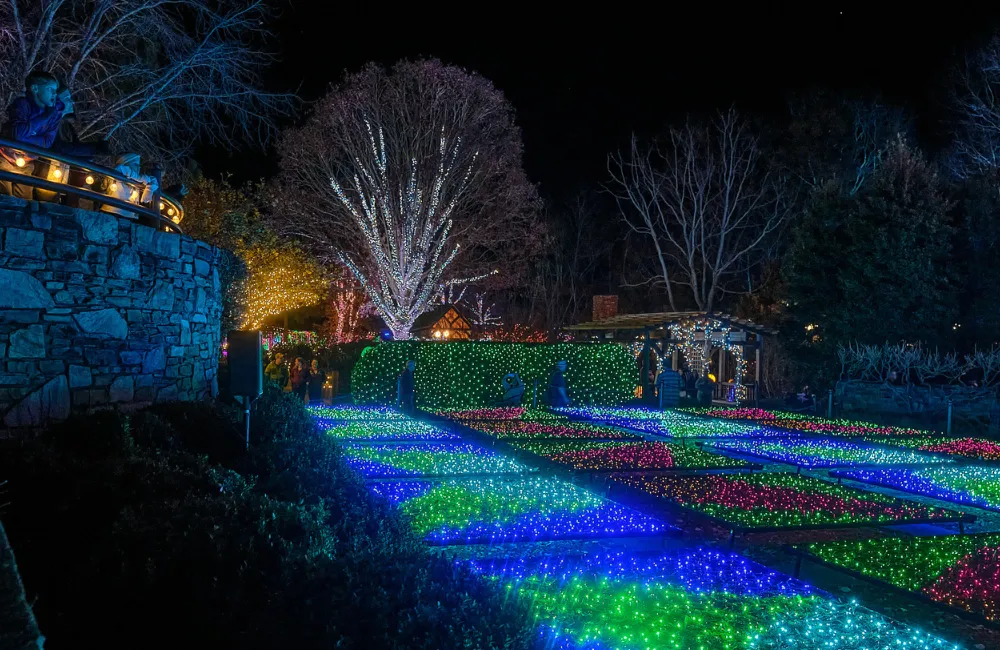
Patterned ground lighting looks best from an elevated viewpoint, like a deck or second-floor window. If you view it from ground level, the shapes flatten and can look like light spills rather than patterns. Also keep the lenses above grass height — overgrown winter turf will block the beam and turn crisp edges into fuzzy blobs. This is a display for properties with elevation changes or a viewing platform, not flat front lawns.
14. Dark Facade with White Icicle Lights and Snow-Reflected Glow
Icicle lights are the most likely to tangle and the first to look dated if several bulbs go out. Buy spare replacement bulbs at the start of the season, and hang icicle strands with clips rather than staples so you can remove them before heavy wet snow freezes them into place. Snow reflection will do some of the work for you, so you can use fewer strands and still get a bright, sparkling facade.
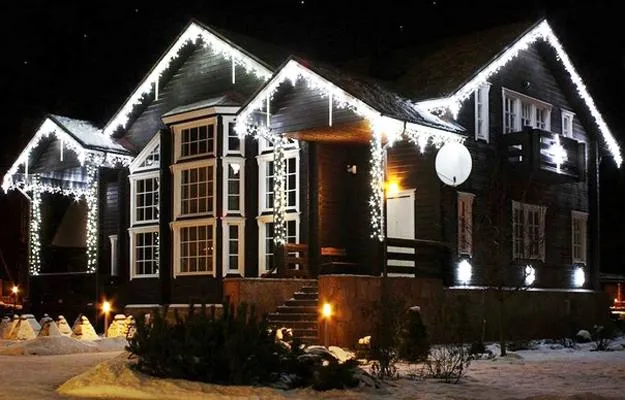
This dark house with white icicle lights works especially well on two-story homes with visible eaves. You want at least 12 to 15 feet of roofline to justify the icicle effect. On a single-story ranch, icicle lights can visually lower the house and make it feel like a curtain rather than an architectural feature. For smaller facades, stick to straight string lights along the gutters instead.
15. Brick House with Candle and Holly Gable Motif and Blue Window Outlines
Anchor a large gable with one bold motif — here, the candle and holly — before you add anything else. The motif gives the entire display a center of gravity, so the blue window outlines and red bush lights don’t compete. Choose a motif that’s at least 18 to 24 inches tall for a two-story house, and hang it from the highest gable point so it reads clearly from the street.
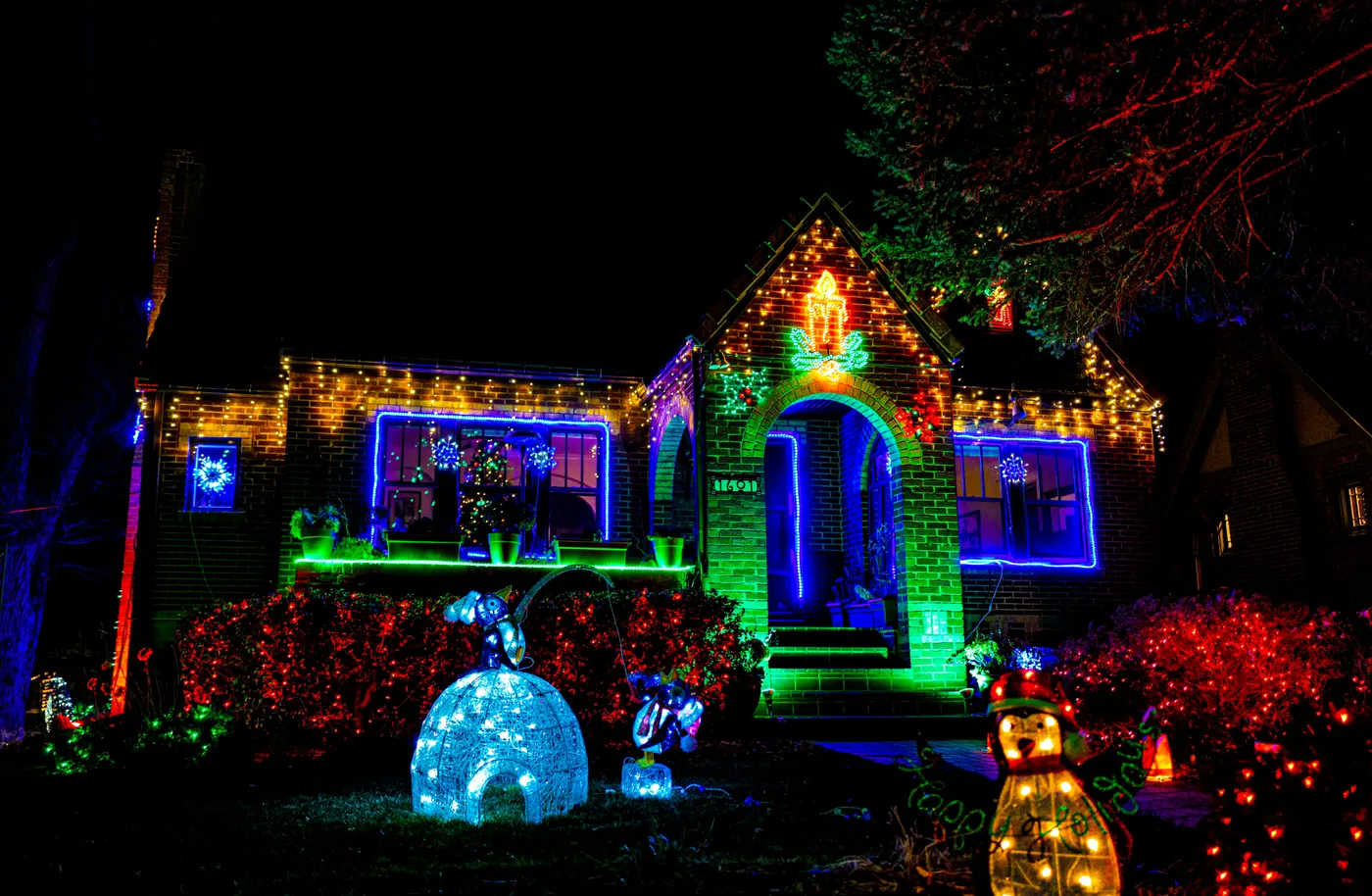
If you look closely, this display is about 50% warm white and blue, 30% red, and 20% green ground lighting. The blue outlines on windows and archways cool down the brick, while the red bushes add warmth at the bottom. You can swap the blue for teal and the red for magenta and keep the same visual formula without losing the festive punch.
16. Blue and Cyan Pixel Art Display with Light-Up Candy Canes and a Star
The blue and cyan palette unifies an otherwise busy collection of shapes. A large star, Christmas trees, candy canes, and circular patterns could easily become visual noise, but the limited cool color range makes them feel like one cohesive animated scene. The occasional red and white accents pop without fighting the blue, so your eye knows where to land first.
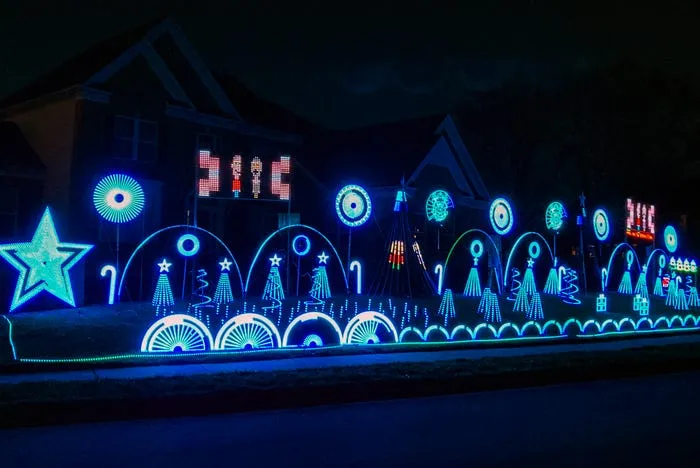
To build a simple pixel-art star, draw a 12-by-12 grid on a plywood panel, drill holes at the outline points, and push a blue LED pixel node through each hole. Wire the nodes to a music-sync or timer controller and mount the panel to a fence post. Plan for about four hours and $60–$120 in pixels and controller parts, depending on whether you already have a power supply.
17. Parade Float Inspiration with Illuminated Reindeer and Tree-Lined Street Glow
Parade-style displays are trickling into residential front yards because people want more than static lighting. The illuminated reindeer and sleigh create a sense of motion, even when they’re rooted in place. In 2026, expect more kinetic and theatrical elements — moving heads, projection mapping, and animatronic-style silhouettes — as homeowners bring the festive street energy home.
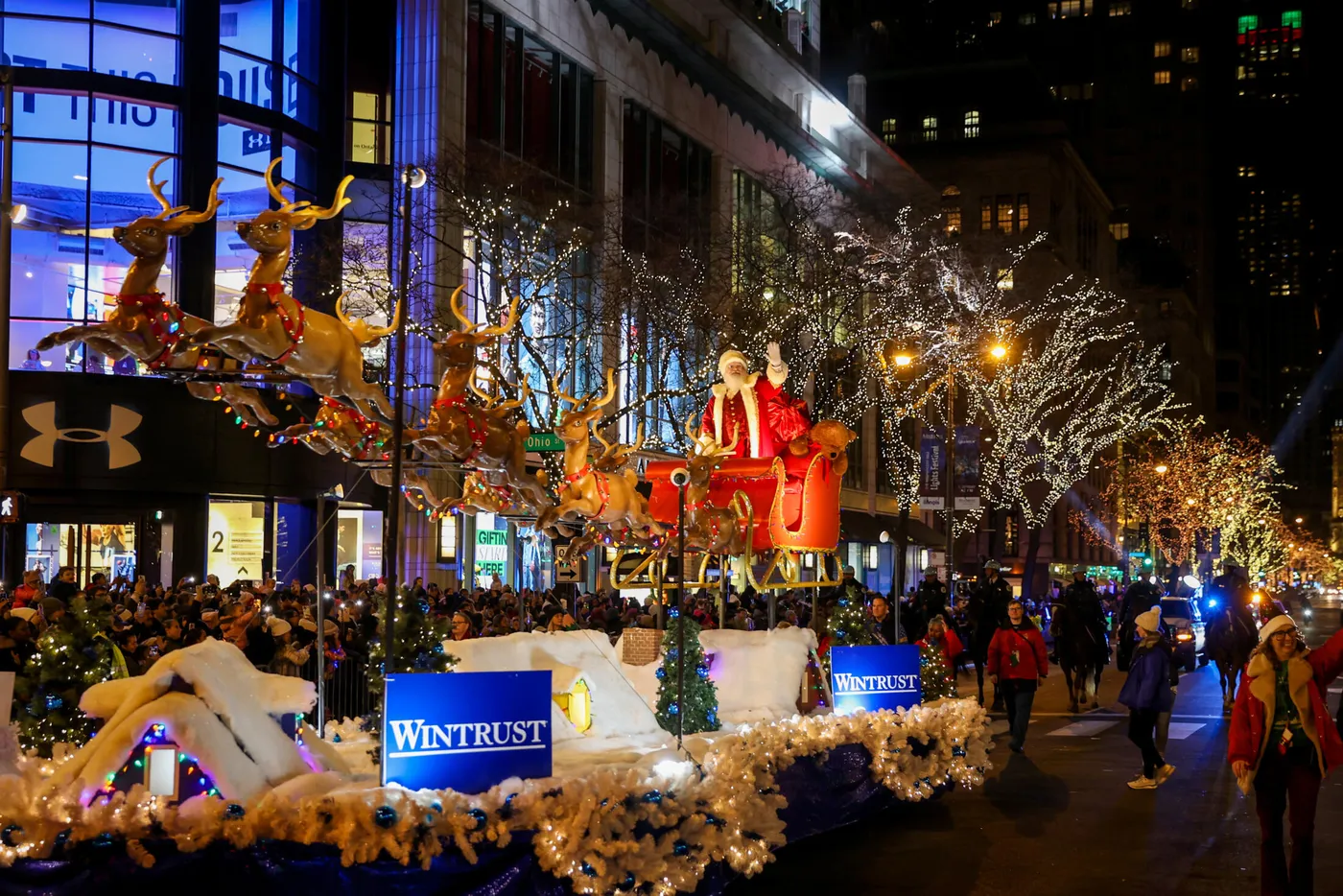
This look implies scale and movement, which can be hard to pull off on a narrow lot. Full-size reindeer figures need about 8 to 10 feet of clear yard depth, and the sleigh needs a sturdy base to survive wind. If you only have a small strip, shrink the scene to a single reindeer and a small sleigh planter. And remember, moving parts and projections need more than a timer — they need a plan for overnight noise and light spill.
18. Neon Lightbulb Characters and Gingerbread Men in a Suburban Yard
Giant lightbulb characters can be faked with plywood cutouts, string light frames, or printed vinyl faces on corrugated plastic. LED strip outlines from Amazon or Walmart cost about $20 per character, and a full gingerbread family can be done for under $120. The key is to keep the shapes simple and use one bright color per character so they read from the curb at night.
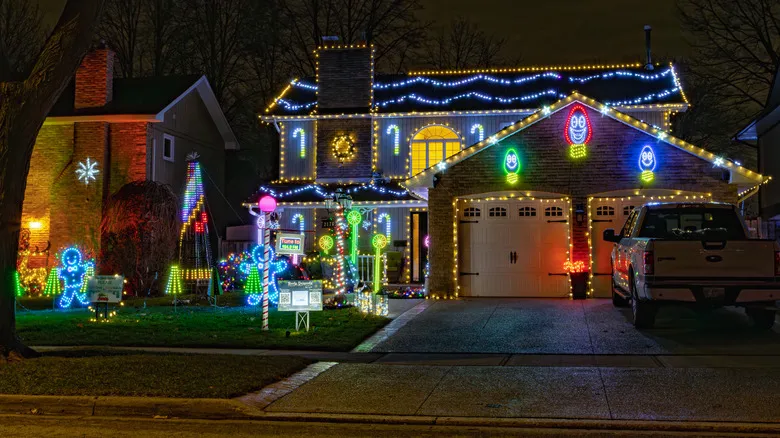
Use the tall geometric Christmas tree light structure as your vertical punctuation. When a yard is full of small figures, one tall element prevents the display from becoming a static lawn full of glowing clutter. Place it off-center, not dead center, and build shorter figures around it so the composition has a clear peak. Idea #16 has a similar skyward anchor with its pixel-art star.
19. Multi-Colored Lawn Figures with a Lighted Vehicle and Present Scene
This elaborate lawn scene needs about 2,500 square feet of usable front yard, ideally with the house set back far enough that the figures don’t block each other. If your lot is smaller, choose the vehicle with presents as the hero and skip the secondary snowman clusters. The animated vehicle requires a clear 6-foot envelope around it, both for visual clarity and for troubleshooting the moving parts.
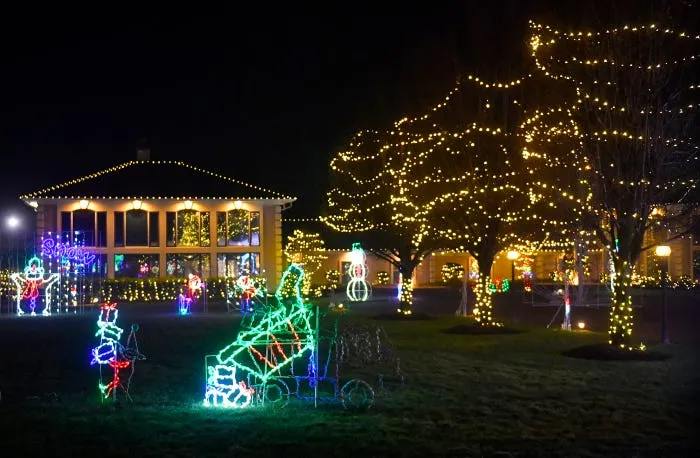
Animated scenes with motors and pulley systems add another layer of maintenance. Check moving parts after heavy rain and before the season starts; lubricate bearings and replace any rusted connectors. Budget about $50–$100 a year for replacement bulbs, timers, and occasional motor repairs. The lawn figures also need to be removed before spring fertilization to avoid dead grass rings.
20. Maximalist Brick House with Nutcracker Inflatable and Lit Snowmen
The dense, unrestricted layering is the whole point here. The brick house, porch garlands, wreaths, nutcracker, and snowmen all compete for attention, yet the composition works because nothing is spaced far apart. Remove the density and you’d be left with a standard decorated house; keep the layers and you get a joyful, almost overwhelming holiday tableau.
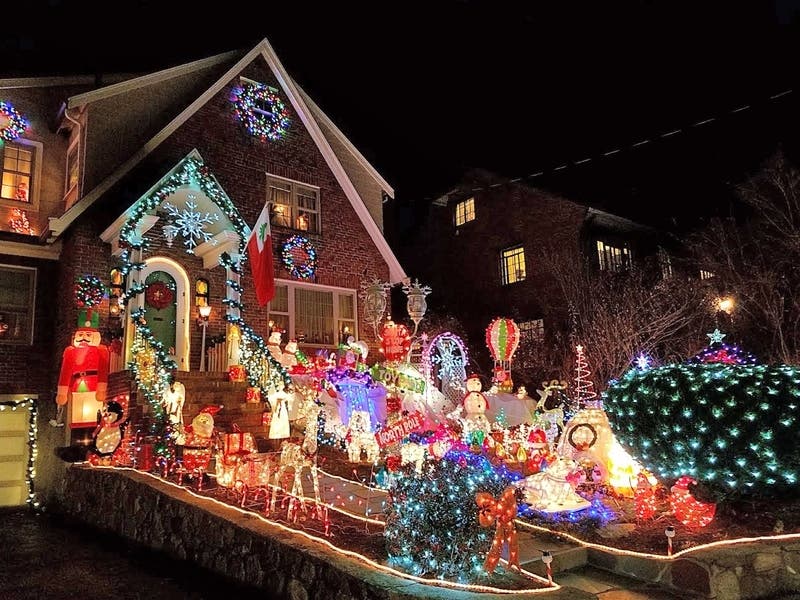
Maximalism works when there’s a shared color language — here red, green, blue, yellow, and white repeat across the house, yard, and inflatables. The brick facade warms the cooler lights, and the wreaths on the windows pull the eye upward. It’s not about balance; it’s about saturation, and that saturation is what makes it photograph so well from the street.
21. Beige Siding with Warm White Roofline, Icicles, and Ground Stake Lights
Icicle lights can look tired if you don’t fluff them after storage. The light-colored siding means every dead bulb and twisted strand is more visible, so test before you hang. Ground stake lights must be pushed into soil that isn’t frozen solid, which can be a problem in colder zones. Do the install before the first hard freeze, or keep a rubber mallet and long drill bit nearby.
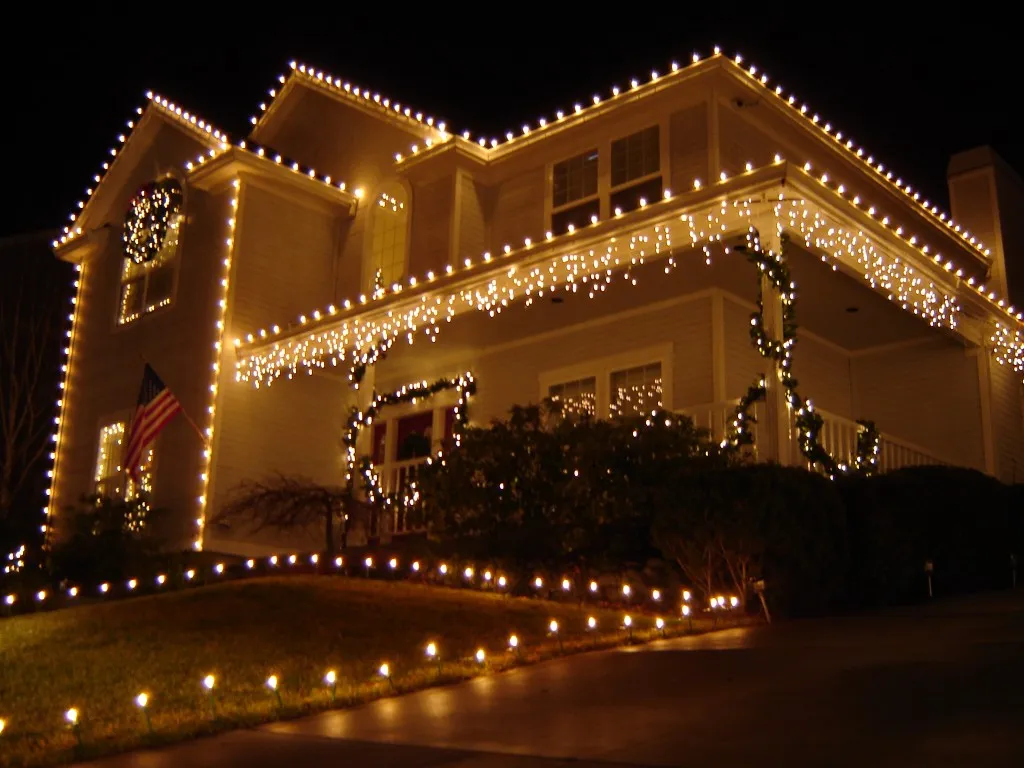
Skip the expensive permanent roofline system and buy LED icicle strings in bundles from Target or Home Depot after Christmas, when they drop below $20 per strand. For the ground perimeter, $25 solar stake lights give a similar glow without running cords. The whole beige-siding look can be recreated for under $180 if you’re willing to shop off-season.
22. Icicle-Lit Roofline with Santa Sleigh and Blue-Purple Bushes
For a wet-ground reflection scene, first position your sleigh and reindeer on the highest point of the lawn so water pools below them, not underneath the electronics. Next, use waterproof low-voltage connectors for all figure cords. Then set your blue and purple bush lights behind the reflection zone to add depth. Finally, take a test photo from the curb after rain and adjust the reindeer angle until the glow reads clearly. Plan for two hours of setup and about $30 in waterproofing supplies.
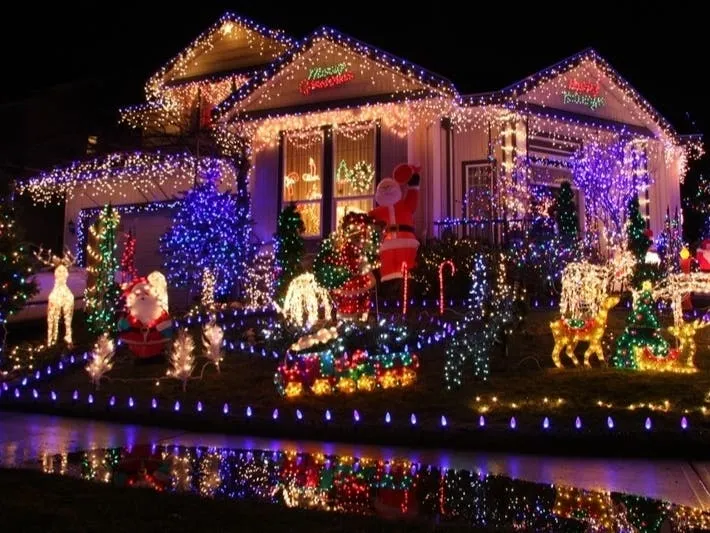
The wet ground here isn’t just weather — it’s an intentional design tool. Reflections make the light display look twice as dense and far more dynamic without adding a single bulb. This aligns with the 2026 emphasis on using existing surfaces, like driveways and walkways, as reflective layers. After rain, even a modest display can look professionally curated.
23. Blue-Purple Conical Tree with Multi-Color Draped Bare Tree and Glowing Figures
To create that tall conical tree, use a tomato cage or an 8-foot pole as the frame, then wrap blue and purple string lights from the base upward in a tight spiral. Top it with a weatherproof star and stake the base with three guy lines so winter wind doesn’t bend it. This one piece will give your entire display a strong vertical anchor and save you from the flat-lawn look. If you want a smaller version, see Idea #16.
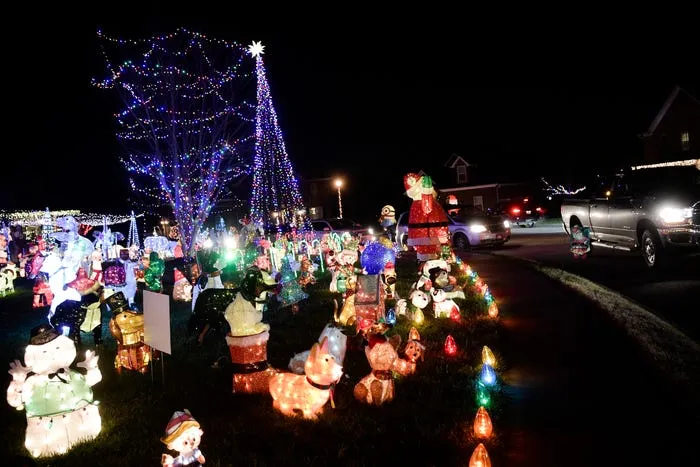
Large-bulb ground lights and conical trees collect moisture and debris. The blue and purple color palette hides some dirt, but the white and red figures will need a wipe-down each season. Store the conical tree frame upright in a garage corner with a trash bag over the star; crushed frames are the number one reason these trees get thrown away after one year.
24. Light Brick Modern House with White Roofline and Red-Bow Wreaths
The symmetry of the light-colored brick and white string lights gives this modern house a formal, almost ceremonial feel. The red bows repeat at the front door, balcony, and upper window, creating a vertical rhythm that pulls your eye from the driveway to the roofline. The lit trees and bushes soften the hardscape and frame the composition like parentheses.
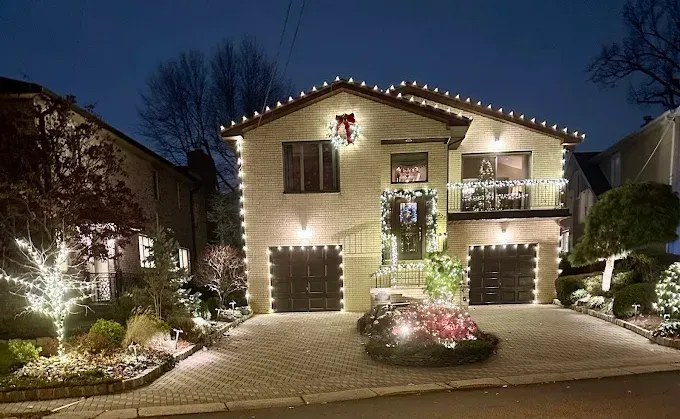
This design wants a two-story facade with visible architectural features, like garage doors and balconies, to outline. Minimum ceiling height isn’t the issue; minimum facade width is. You’ll want at least 40 linear feet across the front for the white roofline to read as grand rather than sparse. On a narrow townhouse, use the same wreath-and-garland rhythm but skip the garage outlines.
25. Black Double-Door Entry with Warm Lit Garland and Santa Boot Planter
The pair of flanking grey planters does the real work here. They anchor the black double doors, add evergreen texture, and give the red berries a place to pop without overtaking the entry. If you removed them, the garland and wreaths would still be lovely, but the entry would feel less grounded and far more generic.
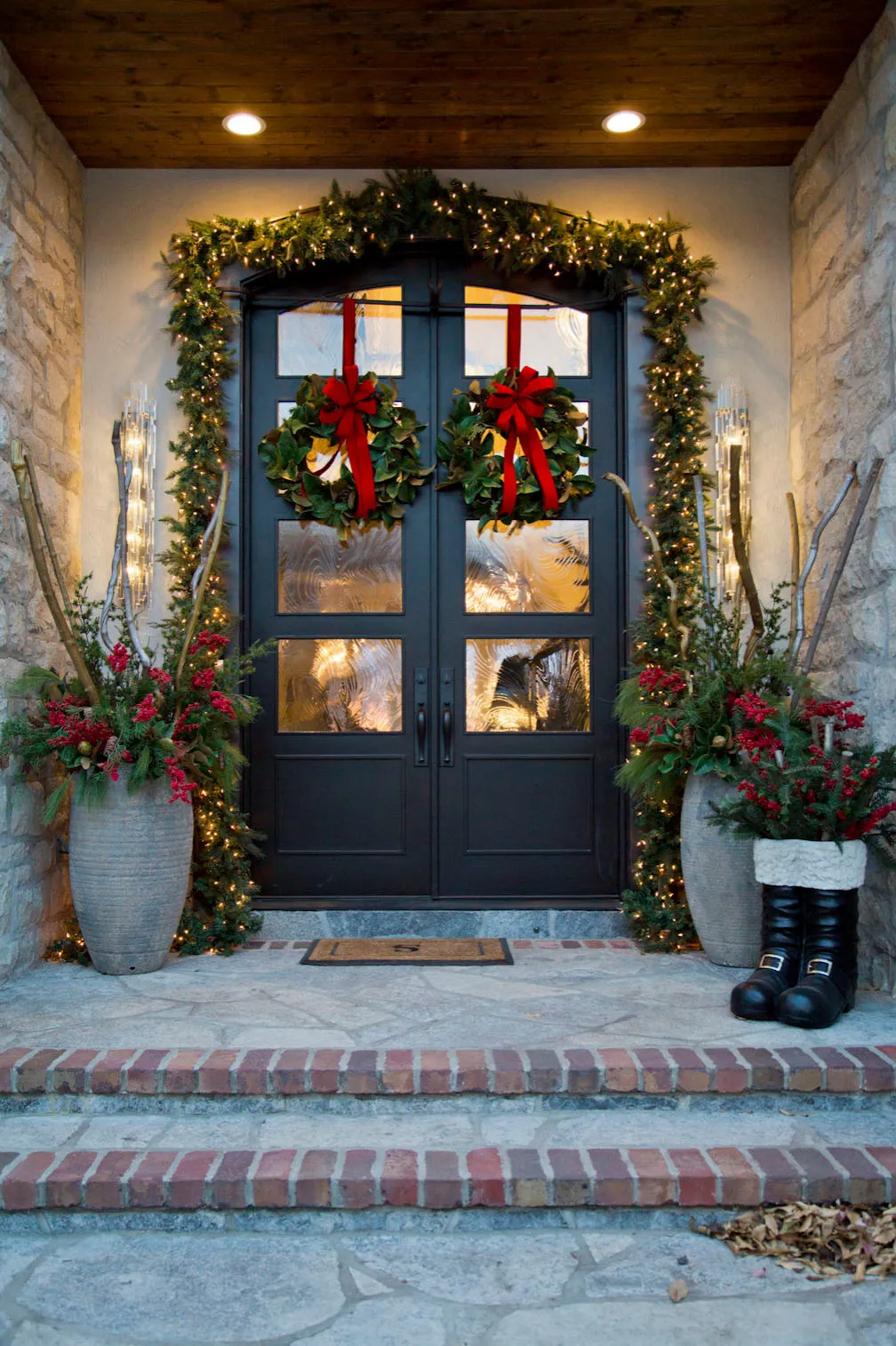
Use real or realistic flocked stems inside planters, then zip-tie a tiny warm white LED string inside each planter before adding the greenery. Keep the light source low and slightly hidden so it glows from within rather than looking like a cord thrown on top. For the Santa boot planter, add a plastic liner with drainage holes so it doesn’t fill with rain.
26. Cream Stucco Home with Warm White Roofline and Glowing Reindeer Pair
Light-up reindeer are easy to find used on Facebook Marketplace after January for $30–$80 each, or you can bend two simple deer silhouettes from heavy-gauge wire and wrap them in warm white mini lights. The big deciduous tree is the real cost driver — an hour of wrapping plus 10–15 strands will put you around $120. The whole yard can be done for under $300 with patience.
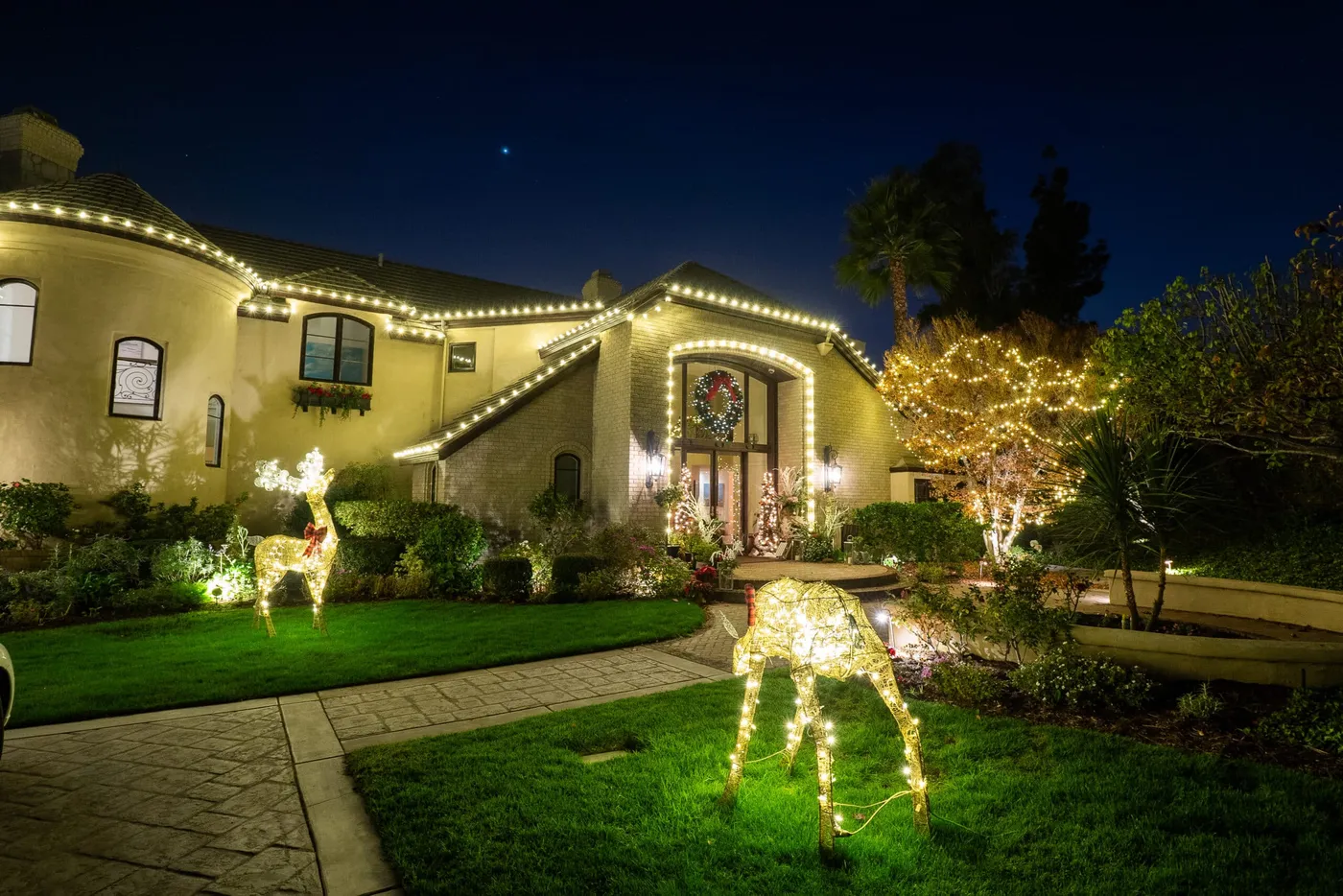
The cream stucco and light brick make the warm white lights feel softer and more inviting than they would on a dark facade. The illuminated deciduous tree is the largest source of light in the yard, so it draws the eye first, then the reindeer pair leads toward the front door. It’s a classic sequence: bright tree, moving glow, red bow, entrance.
27. Red and Turquoise Roofline with a Fully Wrapped Warm White Tree
- Alternating red and turquoise C9 roofline strands: $80–$180
- Warm white garland with red bows for the entry: $60–$140
- Fully wrapped deciduous tree with warm white mini lights: $100–$250
- Stucco-safe clips, extension cords, and timers: $40–$90
- Total: $280–$660
- Budget alternative: $150–$320 using after-season C9 strands and a smaller tree.
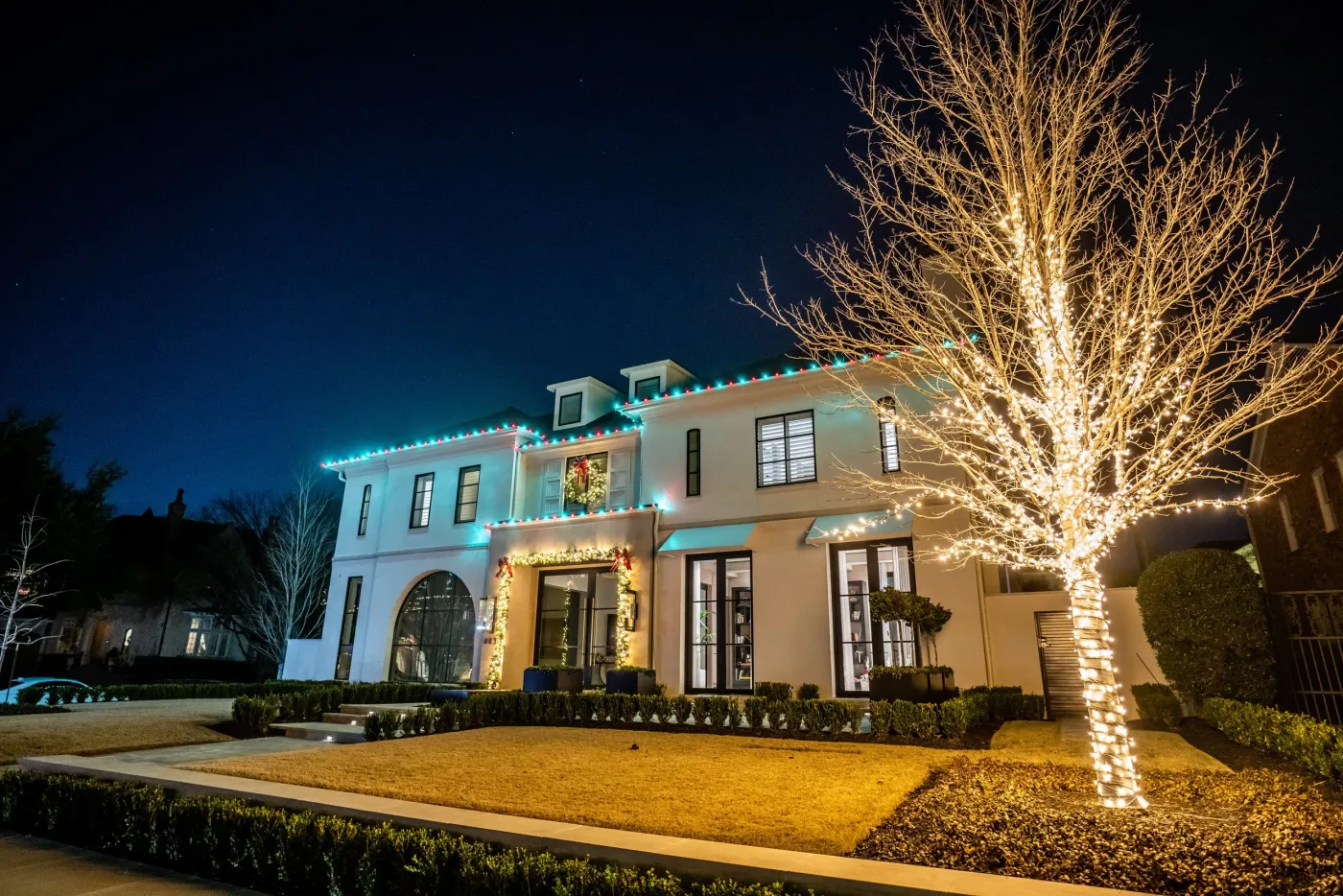
This modern facade can handle the red and turquoise roofline because the house is large enough to carry two strong accent colors without looking busy. You need a visible roofline of at least 30 linear feet and preferably a big deciduous tree to reflect the warm white glow. On smaller ranches, choose red or turquoise — not both — so the eye isn’t pulled in two directions. Compare with Idea #24 for a single-color modern version.
28. Red and Blue Roofline on Brick with Stone Fence Border
Red and blue against brick can turn muddy if the brick already has strong red-brown tones. The blue strands may recede and the red strands may blend into the facade, leaving you with a confusing outline rather than a crisp one. This works best when the brick has a faded or lighter patina, or when you run the lights on the outer eaves against a darker sky. Test one short section before committing to the full roofline.
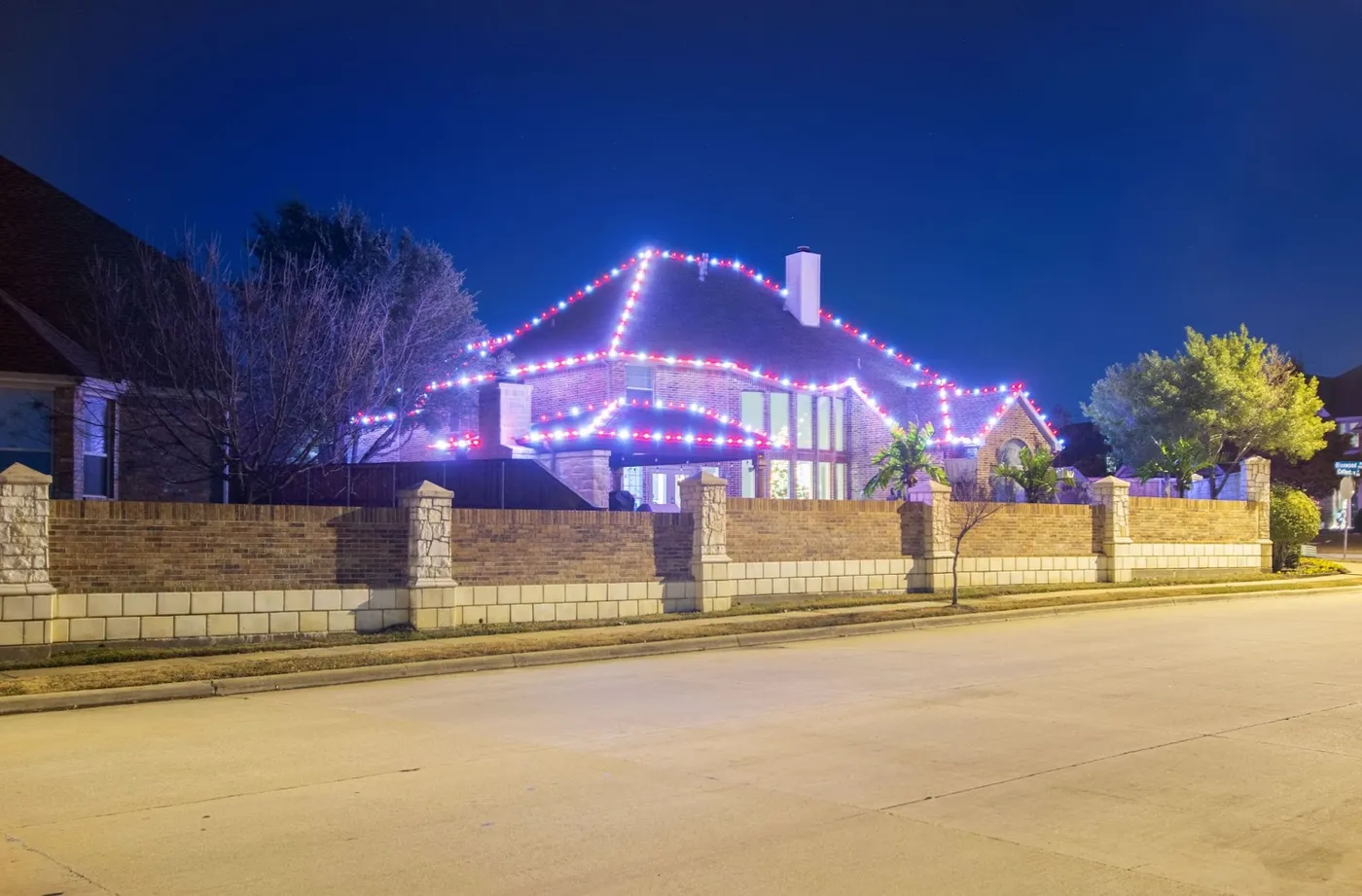
Keep the red and blue strands on separate circuits or channels so you can balance their brightness. Blue LEDs often appear dimmer than red at the same wattage, so you may need to run blue at slightly higher output or use more blue bulbs per linear foot. The stone fence below also reflects light, so point any ground-level fixtures away from it to avoid a washed-out base.
29. Snow-Covered Colonial with Warm White Windows and Wreaths
Snow-covered evergreen bushes with warm white string lights are the element that makes this colonial scene feel cozy rather than staged. The snow reflects the warm light upward, filling the space between the porch and the ground with a soft glow. Without that white blanket, the same display would feel much starker and less like a holiday postcard.
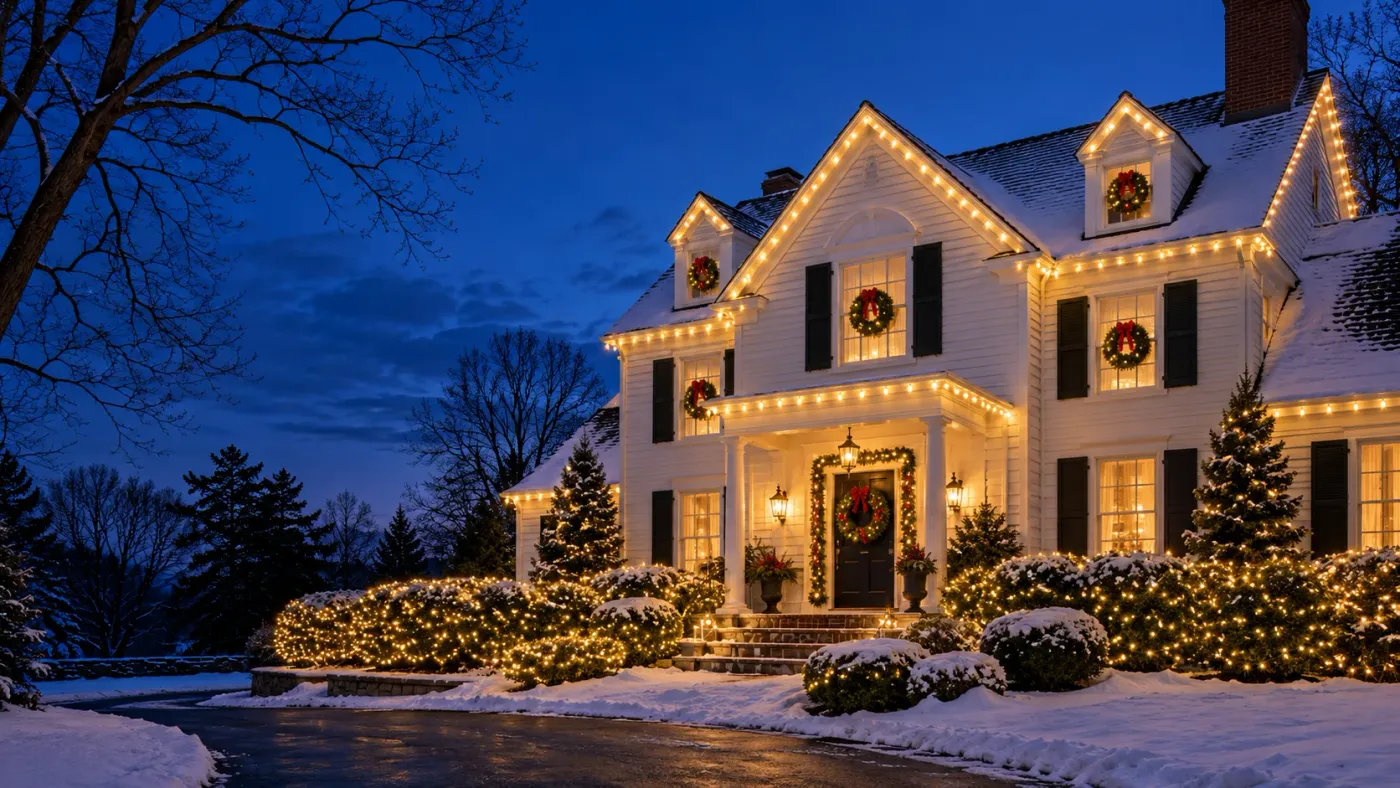
Snow increases visual charm but shortens outdoor strand life. Icicles and snowmelt can work their way into connectors, so use waterproof wire nuts and keep plugs off the ground. After heavy snow, gently brush off strands rather than pulling them, because frozen bulbs snap. Store lights indoors in January so the wiring doesn’t sit in freeze-thaw cycles all winter.
30. Snow-Dusted Lawn with Angel, Train, and Rooftop Santa Sleigh
Scene-based displays — a light-up train, an angel, gift boxes, and a rooftop sleigh — are replacing random front-yard assortments in 2026. Homeowners are thinking of their yards as still lifes with a beginning, middle, and end. This gives the display a narrative, and it’s particularly popular on Pinterest because each piece can be saved and planned as part of a scene.
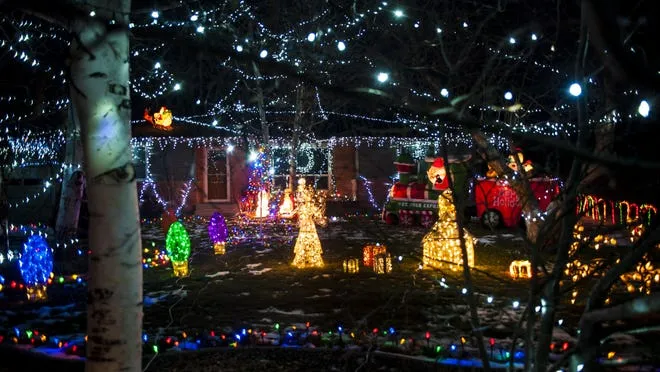
A display this dense needs a yard that’s visible from the street and at least 30 feet deep, or the pieces will hide each other. The rooftop sleigh works best on a single-story roofline so it can be safely anchored at the peak. If your lot is compact, choose one hero piece like the angel or train and build the scene around it, then save the full tableau for a larger front lawn.
31. Stone Entry with Bare Trees Fully Wrapped and Garland-Lined Steps
The formula here is about 80% warm white light, 15% evergreen garland, and 5% red bow accents. The bare trees wrapped in warm white give the stone and stucco a soft, flattering glow, while the green garland absorbs light and the red bows add tiny moments of contrast. Swap the warm white for golden amber and the red bows for burgundy if you want the same elegant entrance with a slightly more rustic feel.
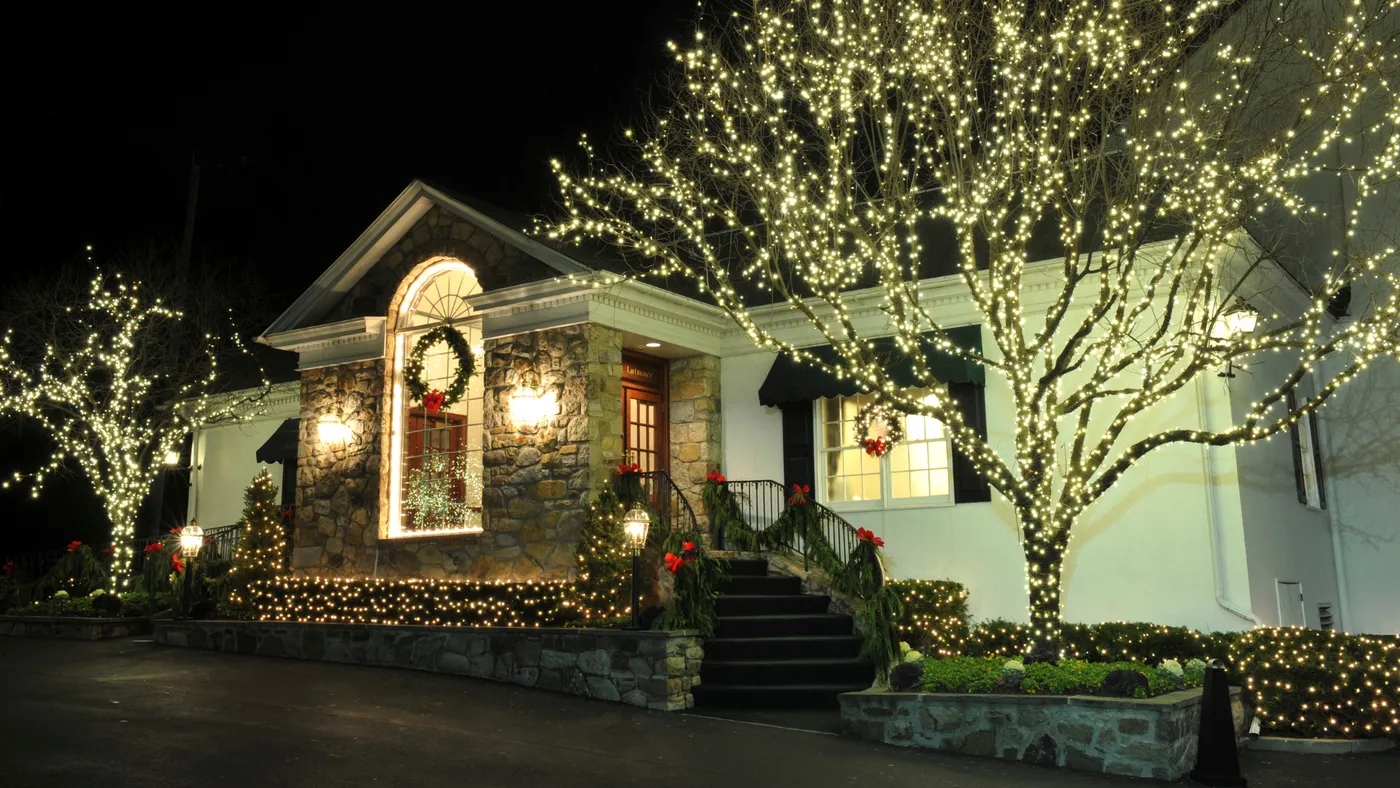
The large arched window with a wreath acts as a focal point, while the bare tree lights frame the entrance from above. Because the stone has so much texture, the warm white light creates soft shadows that add depth. The black steps and dark green garland then ground the composition so the whole entrance feels anchored, even at night.
32. Grand Stone and Shingle House with Snowy Yard and Spherical Topiaries
Use the illuminated spherical topiaries as a repeated motif down the walkway or along the garage line. Their round shape reads as modern and formal, especially against snow. Space them 3 to 4 feet apart and run their cords under the snow or mulch so you don’t create trip hazards. The blue light sculpture in the yard should sit at the end of the path, not off to the side, so it pulls your eye through the scene.
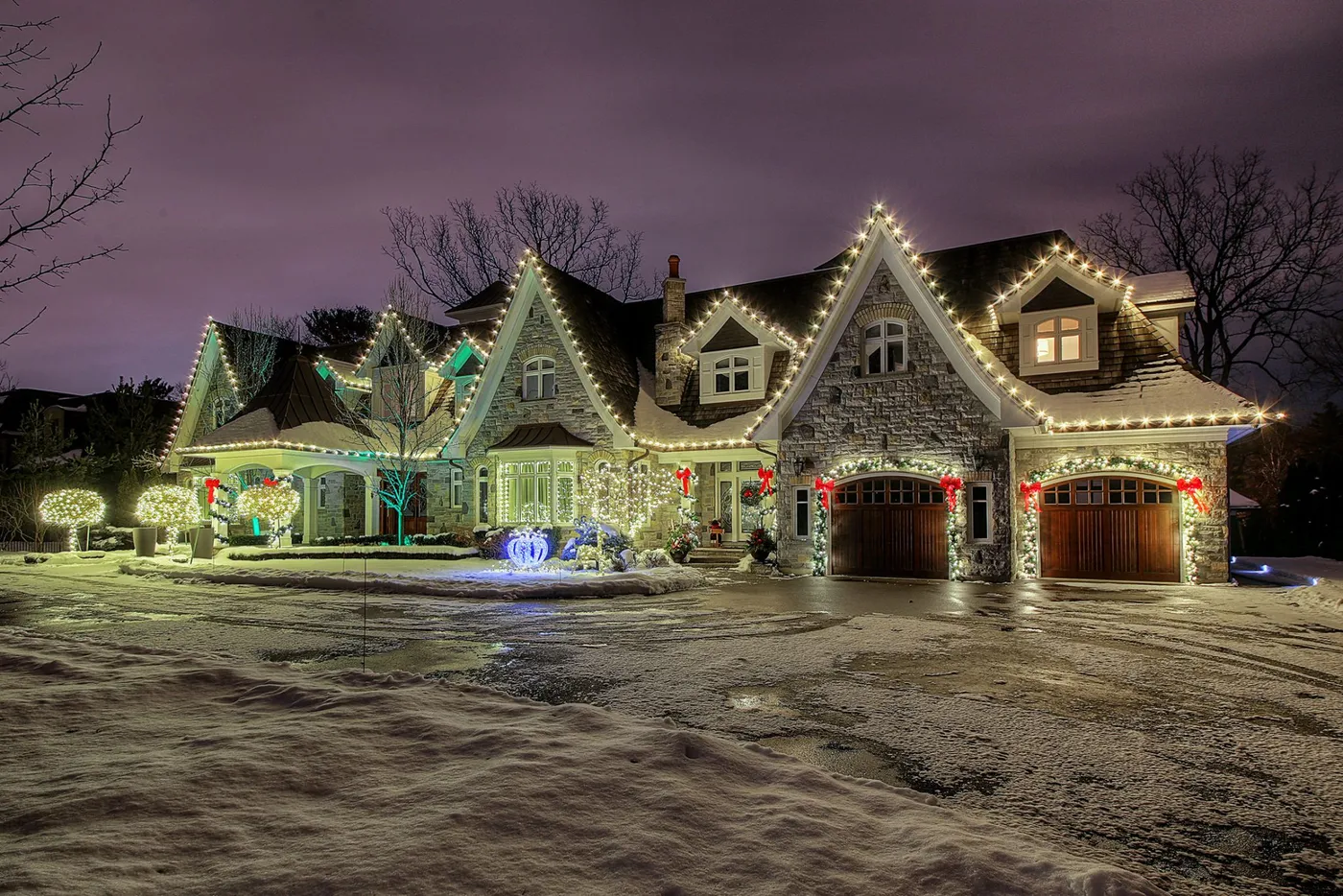
The warm white rooflines on the stone and shingle roof are the backbone of this grand design. They outline every gable and dormer so the house reads as a single, cohesive shape against the dark sky. Remove them and the garlands and topiaries would look scattered. It’s the roofline that makes the whole property feel intentionally composed.
Now Go Light the Night Like You Mean It
Whether you go full maximalist with inflatables and pixel art or keep it quiet with warm white rooflines and a few wrapped trees, the best display is one you’ll actually enjoy from the street. Start with one strong focal point, layer your lighting, and don’t overthink the small stuff.
Pin your favorite ideas now — you’ll be glad you did when the snow starts falling and the neighbors start asking how you did it.